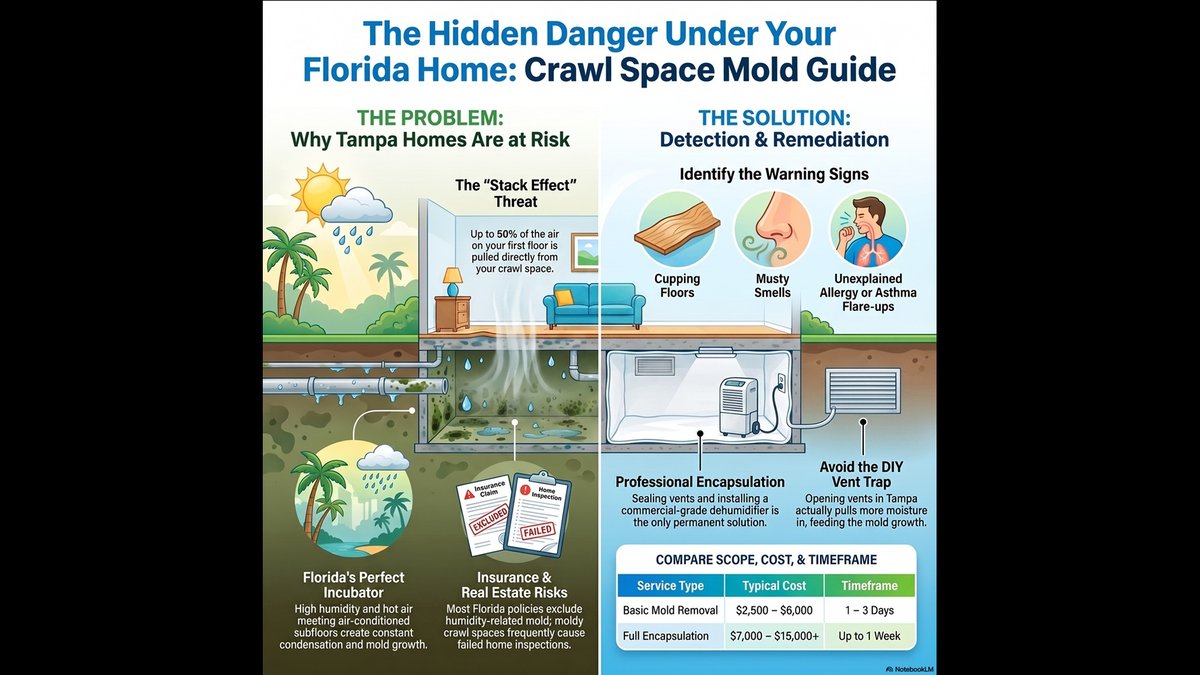
TampaBayMold.net has published a guide addressing 11 common questions and concerns that homeowners in the Tampa Bay area have regarding crawl space mold and its effective removal. The resource distills the most-asked questions into an actionable reference designed to help property owners navigate a widespread problem that threatens both health and home value. Florida ranks as the most mold-prone state in the nation, scoring 38.76 out of 40 on the FDP national Mold Index, and Tampa is consistently flagged among the most susceptible cities. The guide arrives at a critical time for local homeowners facing moisture-related challenges unique to the region.
More information is available at https://tampabaymold.net/services/crawl-space-mold-removal/
Tampa Bay's climate functions as a mold incubator, with environmental conditions that accelerate fungal colonization beneath homes. The area's average annual humidity hovers around 74.5 percent, well above the EPA and CDC recommended range of 30 to 50 percent for indoor environments. When indoor relative humidity exceeds 70 percent, mold can begin colonizing surfaces in as little as 24 to 48 hours, a widely accepted fact in building science and environmental health often cited by organizations like the EPA. Heavy summer rains, an elevated water table, and condensation caused by the stack effect combine to create persistent moisture under homes. The stack effect occurs where hot, humid outdoor air meets cooler air-conditioned subfloors, fueling rapid mold growth in crawl spaces throughout the region.
The financial and health implications of crawl space mold make professional guidance necessary for Tampa Bay homeowners. Remediation costs typically range from $2,500 to $6,000, though encapsulation projects average $5,550 and can exceed $15,000 for severe cases involving structural damage or extensive moisture control systems. Mold, standing water, or rotting joists discovered during real estate transactions can reduce a home's resale value by 20 to 37 percent and cause 50 percent of interested buyers to withdraw, according to independent real estate statistics. Standard Florida homeowners insurance policies generally exclude mold damage unless it results from a sudden, covered peril such as a burst pipe. This places the financial burden squarely on property owners who must address long-term humidity and ventilation issues as maintenance concerns.
The guide covers detection methods, health risks, and the stack effect that directly impacts indoor air quality. Homeowners learn to recognize early warning signs such as musty odors, cupping floors, elevated indoor humidity, and unexplained allergy flare-ups without needing to access the crawl space itself. Up to 50 percent of the air on a home's first floor is drawn from the crawl space due to the stack effect. Mold spores and dampness from beneath the house are continuously pulled into living areas, making hidden contamination a direct threat to residents' wellbeing. This connection between unseen crawl space conditions and felt health impacts underscores why early detection and intervention matter for Tampa Bay families.
Professional remediation, encapsulation, and long-term prevention strategies form the core of the guide's practical advice. The resource explains why DIY removal is both ineffective and dangerous in confined spaces with poor ventilation. It also details how encapsulation prevents mold recurrence by sealing vents and installing vapor barriers, and the role of commercial-grade dehumidifiers in managing Florida's relentless moisture load. Encapsulation is presented as the most effective permanent solution for Tampa Bay's humid environment. The entire remediation process typically takes one to three days for removal alone, though full encapsulation projects may extend up to a week when structural repairs or drainage systems are included.
The guide from TampaBayMold.net serves as a reference for informed decision-making, equipping homeowners with the knowledge needed to protect property value, health, and financial interests. The company has created a localized authority addressing a critical issue affecting the Tampa Bay housing market and resident health, offering answers to the 11 most common homeowner questions about crawl space mold removal in the region. Homeowners can access the full guide and additional resources to make informed choices about remediation, encapsulation, and moisture control strategies tailored to the unique challenges of Florida's Gulf Coast climate.
For more details, visit https://www.tampabaymold.net