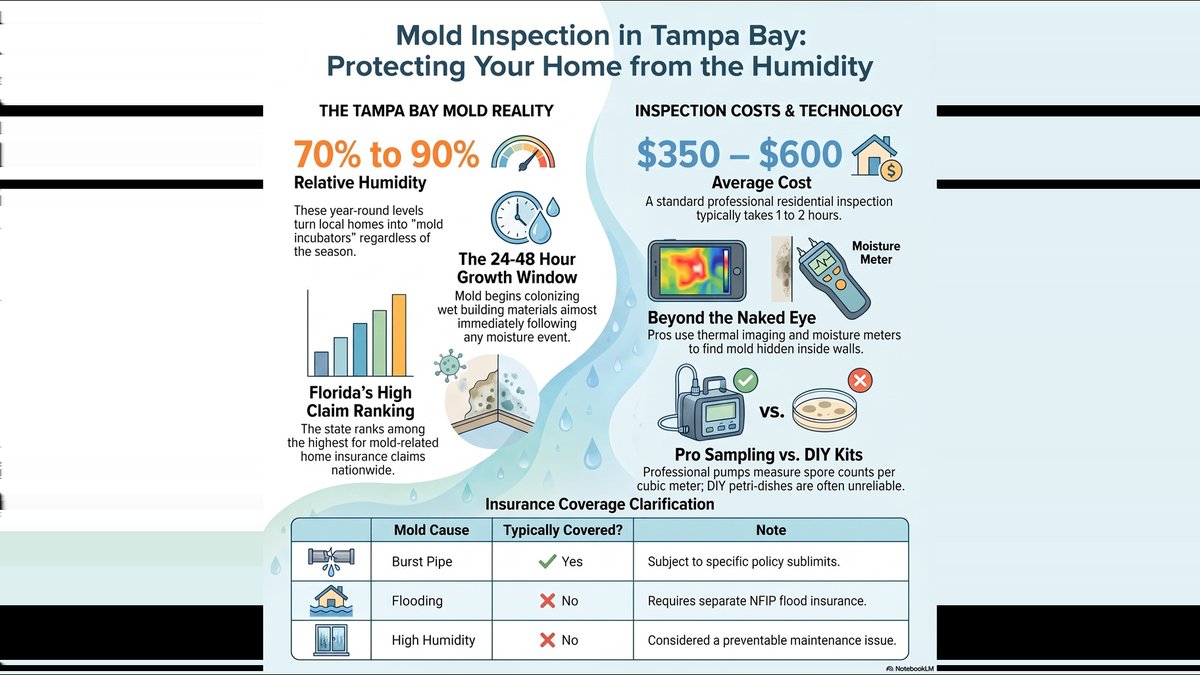
- Tampa Bay's humidity regularly hits 70-90%, creating year-round mold risk - not just during storm season, making routine inspections a smart home safety habit, not an overreaction.
- A mold inspection and a mold test are two different services - knowing which one you actually need can save hundreds of dollars and prevent unnecessary work.
- Standard home inspections won't catch hidden mold - buyers in Tampa Bay's fast-moving market are especially at risk of closing on a home with a costly mold problem already inside the walls.
- Most Florida homeowners insurance policies cap mold coverage at $10,000 - a figure that can fall far short of what a real infestation costs to fix.
- There's a narrow window after water damage where mold can be stopped before it spreads - keep reading to find out exactly how short that window is.
For homeowners across Hillsborough, Pinellas, Pasco, Polk, and Hernando counties, mold is practically built into the environment. TampaBayMold.net has been fielding questions from local families about mold inspections for over 14 years, and the same questions surface again and again. Here are the most important ones, answered directly.
Tampa Bay's Climate Makes Mold a Significant Risk
Most of the country gets a seasonal break from mold pressure. Tampa Bay doesn't. Relative humidity here regularly sits between 70% and 90%, and the area receives approximately 49.5 to 57 inches of rain per year. That's the baseline - not a temporary spike. Once indoor humidity climbs above 60%, mold can colonize within 24 to 48 hours of a moisture event. A slow roof leak, condensation from an overworked AC unit, or poor bathroom ventilation is all it takes.
The subtropical climate means even January rarely drops to humidity levels that discourage mold growth. Attics, wall cavities, crawl spaces, and HVAC systems sit in near-perfect mold conditions year-round - and because mold often starts hidden, homeowners frequently don't realize there's a problem until it's already expensive to fix.
Inspection vs. Testing: Know the Difference
A mold inspection is a physical walkthrough by a trained professional. The inspector evaluates visible mold growth, moisture sources, water damage history, and conditions likely to produce mold. A mold test involves collecting air or surface samples and sending them to a laboratory to identify specific mold species and spore concentrations. These are related but distinct services - conflating them leads to spending money on the wrong one.
The EPA is clear on this: when visible mold is present, sampling is usually unnecessary. A visual inspection by a qualified professional is typically sufficient to identify the problem and plan remediation. Testing adds value in specific situations, but inspection almost always comes first.
When Testing Is Actually Necessary: Hidden Mold, Health Concerns, and Legal Purposes
Lab testing earns its cost when mold is suspected but not visible - think musty odors with no obvious source, or occupants with unexplained respiratory symptoms. It's also valuable for post-remediation verification and for real estate or legal documentation where species identification matters. A Wesley Chapel homeowner whose allergies worsened every time the AC ran had air testing confirm Aspergillus growing inside the ductwork - invisible to any visual check. Symptoms cleared after remediation and filter replacement. That's the scenario where testing pays for itself.
What a Professional Inspection Really Involves
A thorough mold inspection of a typical Tampa Bay single-family home takes roughly one to two hours. Larger homes with attic access, crawl spaces, or complex HVAC systems may run closer to two to three hours. The inspector isn't just scanning for green or black spots - they're systematically evaluating every area where moisture accumulates, where water has historically intruded, and where ventilation is inadequate.
That means checking the obvious spots (bathrooms, kitchens, laundry rooms) and the less obvious ones: inside air handlers and drain pans, beneath flooring near exterior walls, above drop ceilings, and inside ductwork. Secondary indicators like water staining, peeling paint, warped baseboards, and musty odors are just as important as visible mold growth itself.
Tools Inspectors Use to Find Hidden Mold
Moisture meters measure water content inside building materials - wood readings above 17-18% signal conditions where mold is likely already growing. Thermal imaging cameras detect temperature differentials inside walls: wet materials cool differently than dry ones, revealing moisture intrusion as a thermal signature without cutting into walls. Some inspectors also deploy borescopes - small cameras on flexible cables - to look inside wall cavities directly. Together, these tools give an inspector a reliable picture of what's happening inside the structure, not just on its surface.
Where Tampa Bay Homes Are Most Vulnerable
The locations Tampa Bay homeowners most consistently miss: the interior of HVAC air handlers and drain pans, wall cavities behind shower surrounds (especially in older homes with fiberglass surrounds installed over drywall), beneath refrigerators and dishwashers where slow drips go unnoticed for months, and attic spaces near roof penetrations. These are exactly the areas a professional inspector prioritizes - because the same patterns repeat across thousands of local homes.
What Does a Mold Inspection Cost in Tampa Bay?
A standard residential mold inspection in Tampa Bay typically runs $350 to $600, depending on home size, accessibility of problem areas, and whether lab testing is included. If air or surface samples are collected, expect to add $75 to $150 per sample for lab analysis. Attics, crawl spaces, and wall cavity access push costs toward the higher end.
Why Florida Inspections Cost More Than Other States
Florida law requires licensed mold assessors - a credentialing standard that not every state imposes. Add to that the need for professional-grade thermal imaging equipment (a necessity in a climate where hidden moisture is the norm), and the year-round mold season that keeps demand steady. These prices reflect the regulatory and environmental reality of inspecting homes in one of the most mold-prone regions in the country.
Why Cheap Inspections Cost More Long-Term
Some companies advertise inspections under $100. These are often loss-leader pricing models where the inspector also sells remediation - a structure that creates obvious incentives to find problems worth remediating. A $75 inspection that misses hidden mold behind a bathroom wall can lead to thousands of dollars in structural damage six months later. An independent inspection with no financial stake in the remediation outcome is almost always the more economical choice.
Should You Buy a Tampa Home Without One?
Buying a home in Tampa Bay without a dedicated mold inspection is a significant financial risk. Florida's seller disclosure requirements don't always explicitly cover mold, and sellers may not even know about hidden growth inside wall cavities. Relying on disclosure forms as protection is a gamble that rarely pays off.
Why a Standard Home Inspection Falls Short
A licensed home inspector evaluates dozens of systems in a single visit - roof, electrical, plumbing, HVAC. Their scope is intentionally broad. Mold detection requires a completely different focus: understanding moisture migration, airflow patterns, building envelope vulnerabilities, and the specific conditions that allow mold to colonize materials inside walls and under floors. Standard home inspectors are not trained or equipped for that evaluation. A professional mold inspection run concurrently with the standard inspection keeps the timeline tight without cutting corners on due diligence.
A real illustration of the stakes: a buyer in Seminole, FL closed on a home after a standard inspection passed. Three months later, a musty smell prompted a mold inspection - results confirmed Chaetomium and Penicillium inside two bathroom walls and beneath the master bedroom floor, from a slow shower pan leak ongoing for over a year. Total remediation cost: $11,400. A pre-purchase inspection at $350 would have flagged the elevated moisture readings in those exact areas.
Using Mold Findings in Purchase Negotiations
A mold inspection report with confirmed findings and lab-verified species identification gives buyers real negotiating leverage. Options include requesting the seller fund remediation before closing, negotiating a price reduction, asking for a closing credit, or walking away entirely if the findings are severe - assuming the contract includes an inspection contingency, which it should. A professional written report is far harder for a seller's agent to dismiss than a verbal concern.
What Happens After the Inspection
After the inspection, a written report documents every finding: areas of visible mold, elevated moisture readings, suspected hidden growth, lab results if testing was done, and recommended next steps. Not every inspection ends with a remediation recommendation - sometimes a single bathroom with minor surface mold can be resolved with targeted cleaning and better ventilation. Other times the findings require professional remediation. A trustworthy inspector explains the difference honestly.
How to Read Your Mold Report: Key Components Explained
A solid mold inspection report includes: date and inspection scope, a property overview, findings organized by location, moisture meter readings with flagged areas, photographs of problem areas, lab results with spore counts and species identification (if testing was performed), and a prioritized recommendations section. Pay particular attention to any location where moisture readings are elevated even without visible mold - that's where the next growth is most likely to appear. If a report lacks photographs, specific readings, or clear recommendations, ask for clarification before authorizing any remediation work.
What Florida Insurance Actually Covers
Florida homeowners insurance coverage for mold is routinely misunderstood. Most standard policies cover mold only when it results directly from a covered peril - typically a sudden, accidental water loss like a burst pipe or appliance failure. Policies almost universally exclude mold from flooding (which requires separate NFIP flood insurance), long-term slow leaks, poor ventilation, and humidity - all classified as maintenance issues the homeowner should have been managing. This exclusion catches many Tampa Bay homeowners off guard, especially after hurricane season.
Coverage Limits That Surprise Most Homeowners
Many Florida policies cap mold coverage at $10,000 per occurrence. That figure sounds significant until a whole-house remediation estimate comes in at $30,000 to $60,000 after a major water event. Some insurers offer mold endorsements that raise these limits for an additional premium - worth evaluating given Tampa Bay's climate profile. The inspection cost itself is rarely covered separately; most policies cover remediation costs when applicable, not the cost of identifying the problem. Read your Declarations Page and the mold-specific section of your policy directly - the details are almost never in the summary.
How Often Tampa Bay Homes Need Inspection
For most Tampa Bay homeowners, a professional mold inspection every one to two years is a reasonable baseline - but that schedule should accelerate any time a moisture event occurs. Slow leaks, HVAC condensation issues, and gradual building envelope degradation create conditions for mold growth quietly and incrementally. Addressing problems early is dramatically more cost-effective than waiting for visible symptoms. After any flooding, pipe failure, or roof leak, don't wait for the next scheduled inspection - the 24-to-48-hour window for stopping mold before it colonizes closes fast.
Tampa Bay Humidity Won't Wait - Neither Should You
Mold in Tampa Bay is a predictable consequence of the climate, the construction methods common in the region, and the relentless moisture pressure that doesn't let up between seasons. The questions answered here reflect what homeowners across five counties are genuinely wrestling with, and the consistent thread running through all of them is this: early action is always less expensive than late action.
TampaBayMold.net provides independent mold inspections across the Tampa Bay area, with over 14 years of local expertise helping homeowners get clear, unbiased answers about what's actually happening inside their homes - visit TampaBayMold.net learn more.