Key Takeaways
- A 16-foot gooseneck dump trailer delivers 10,000 to 16,000+ pound payload capacity, making it suitable for hauling concrete chunks, mixed debris, and heavy demolition materials.
- Diamond C and MAXX-D models offer robust frame construction with GVWR ratings up to 23,000 pounds, providing the durability needed for demanding commercial demolition work.
- Critical systems, including hydraulic power, reinforced I-beam frames, and heavy-duty axles determine whether a trailer can handle the concentrated loads and abuse of active demolition sites.
Commercial contractors tackling demolition projects need equipment that won't fail under pressure. A 16-foot gooseneck dump trailer represents a critical piece of machinery for hauling away debris efficiently and safely. Understanding the real-world capacity and limitations of these trailers can mean the difference between profitable job completion and costly equipment failure.
Variable Payload Capacity: 10,000 to 16,000+ Pounds
The payload capacity of a 16-foot gooseneck dump trailer varies significantly based on the gross vehicle weight rating (GVWR) and frame construction. Entry-level models with 14,000-pound GVWR typically offer around 10,000 pounds of usable payload, while heavy-duty units can exceed 16,000 pounds of carrying capacity.
This capacity difference matters tremendously for demolition work. Mixed construction and demolition debris averages 417-484 pounds per cubic yard, meaning a lower-capacity trailer might handle 20-24 cubic yards of mixed debris. However, concrete debris presents a different challenge entirely, weighing 1,400 to 4,200 pounds per cubic yard depending on density and aggregate type.
Diamond C vs MAXX-D: Performance Comparison
The heavy-duty gooseneck dump trailer market for commercial applications features prominent manufacturers such as Diamond C and MAXX-D. Both brands offer 16-foot models, but their approaches to construction and capacity differ in ways that impact demolition performance.
Diamond C LPT210GN: 23,000 lb GVWR Specifications
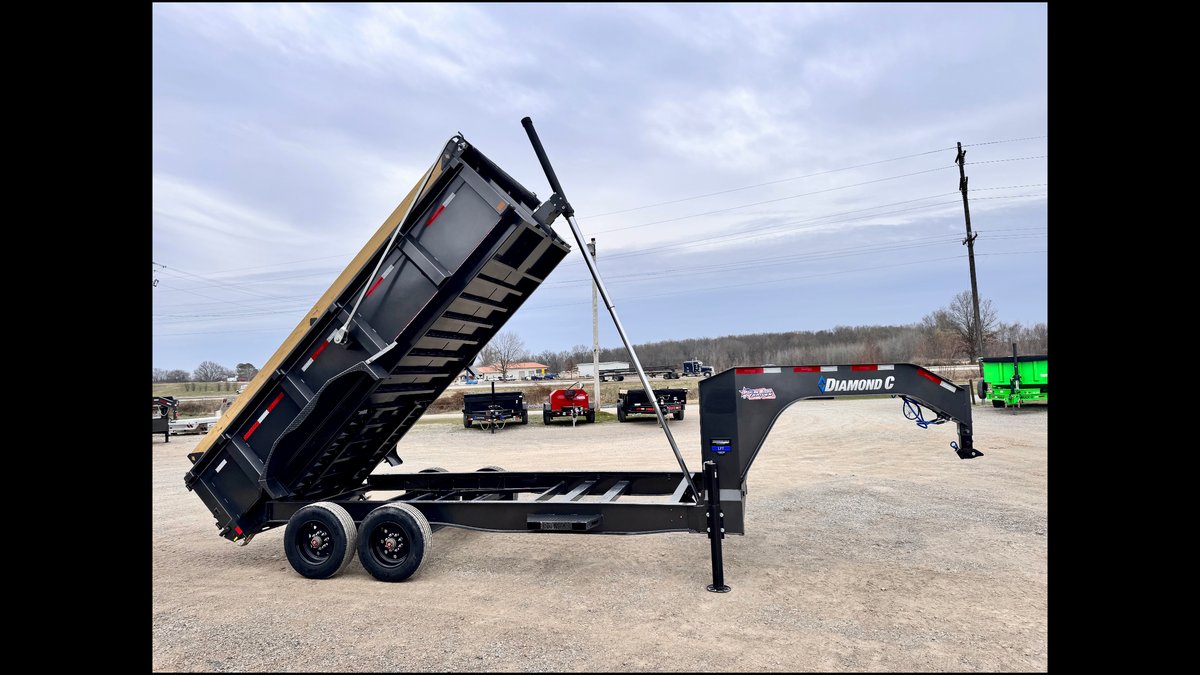
The Diamond C LPT210GN delivers exceptional payload capacity with its 23,000-pound GVWR and 15,900 pounds of available payload. This model features 10-gauge steel for the body and sides, with a 7-gauge steel floor, and 32-inch tall sides that contain loose debris effectively. The engineered I-beam frame with 12-inch center crossmembers provides the structural integrity needed for repeated heavy loading cycles.
Real-world testing has demonstrated this trailer's ability to haul over 16,000 pounds of material successfully. The 3-stage telescopic hydraulic cylinder generates sufficient lifting force to handle dense loads, while the dual 10,000-pound torsion axles distribute weight evenly. ST235/75R17.5 18-ply super single tires provide the load rating necessary for maximum legal payloads on public roads.
MAXX-D DSX8316G: Heavy-Duty Frame Construction
The MAXX-D DSX8316G takes a different approach with its 21,000-pound GVWR, offering a substantial payload capacity that varies based on specific configurations and dry weight. While the exact payload may differ from the Diamond C model, this trailer emphasizes durability through its 10-inch I-beam frame construction and junior crossmembers spaced at 12-inch intervals.
The MAXX-D DSX8316G is designed for extreme heavy-duty hauling, capable of handling significant loads of rock material due to its robust construction. The 3-foot solid sides and 7-gauge floor construction resist damage from sharp debris and heavy impacts. This model particularly appeals to contractors who prioritize long-term durability over maximum single-load capacity.
Critical Systems for Demolition Work
Demolition applications place unique stresses on dump trailers that exceed typical hauling scenarios. Three critical systems determine whether a 16-foot gooseneck trailer will survive in this demanding environment.
Hydraulic Power Requirements
Hydraulic systems must generate sufficient force to lift loads exceeding 20,000 pounds while providing precise control for safe unloading. Demolition debris often shifts during dumping, creating uneven weight distribution that challenges hydraulic cylinders. Premium systems incorporate multi-stage telescopic cylinders that develop maximum force at the beginning of the lift cycle when loads are heaviest.
Power-up, gravity-down systems prove most reliable for commercial applications. These systems use hydraulic power for lifting but rely on gravity for lowering, reducing complexity and potential failure points. Solar charging panels maintain battery power between uses, ensuring consistent performance on remote job sites where truck power might be unavailable.
Frame Strength Under Heavy Loads
Frame construction determines a trailer's ability to withstand concentrated loads and resist fatigue failure over time. Contractor-grade trailers require reinforced steel frames with tighter cross-member spacing than standard models. Heavy-gauge steel floors distribute point loads from dropped concrete chunks and prevent punctures from sharp steel debris.
The main I-beam frame bears the primary structural loads, while cross-members prevent twisting under uneven loading. Proper engineering spaces these cross-members to handle the concentrated loads typical of demolition debris rather than the distributed loads of bulk materials like gravel or soil.
Axle and Tire Ratings
Axle capacity must exceed trailer payload requirements with an adequate safety margin for dynamic loading. Torsion axles provide smoother ride quality and better load distribution compared to leaf spring designs, reducing stress on both the trailer frame and towed vehicle. Dual 10,000-pound axles represent the minimum for serious demolition work, providing 20,000 pounds of total axle capacity.
Tire selection is critical when operating at maximum payloads. 18-ply radial tires rated for heavy loads resist sidewall damage from debris and maintain stability under maximum loading. Super single tire configurations reduce rolling resistance and simplify maintenance while providing adequate load capacity for most demolition applications.
Real-World Demolition Applications
Understanding how 16-foot gooseneck dump trailers perform in actual demolition scenarios helps contractors make informed equipment decisions and optimize their hauling strategies.
Concrete and Heavy Material Transport
Concrete demolition creates the heaviest debris loads that dump trailers encounter. Broken concrete chunks can weigh several hundred pounds individually, creating concentrated point loads that stress trailer floors and frames. A 16-foot trailer with maximum payload capacity might handle only 4-6 cubic yards of concrete debris compared to 20+ cubic yards of mixed construction waste.
Strategic loading is necessary when hauling concrete. Distributing heavy chunks across the trailer bed prevents overloading the front axle and maintains proper tongue weight. Many contractors use mechanical loading equipment to position concrete pieces strategically rather than allowing random placement that could create dangerous weight imbalances.
Mixed Construction Debris Hauling
Mixed debris from building demolition typically includes drywall, lumber, metal fixtures, and occasional concrete elements. This combination creates moderate density loads that fall within the comfort zone of most 16-foot gooseneck trailers. The varied shapes and sizes of mixed debris benefit from the higher side walls available on demolition-spec trailers.
Loading efficiency improves when debris is sorted by density, placing heavier materials over the axles and lighter materials toward the front and rear. This distribution optimizes trailer balance while maximizing payload utilization. Proper tarping becomes necessary for mixed loads to prevent debris from escaping during transport.
Commercial-Grade Solutions Are Available
Commercial contractors require equipment suppliers who understand the demanding nature of demolition work. Proper trailer selection involves matching specific job requirements with appropriate capacity and construction features. Experienced dealers provide guidance on hydraulic systems, frame specifications, and axle ratings that determine long-term performance.
Factory warranties and dealer support are vital when trailers operate under maximum loads daily. Professional maintenance services and parts availability ensure minimal downtime when equipment needs service. Financing options allow contractors to acquire appropriate capacity without depleting working capital needed for ongoing operations.