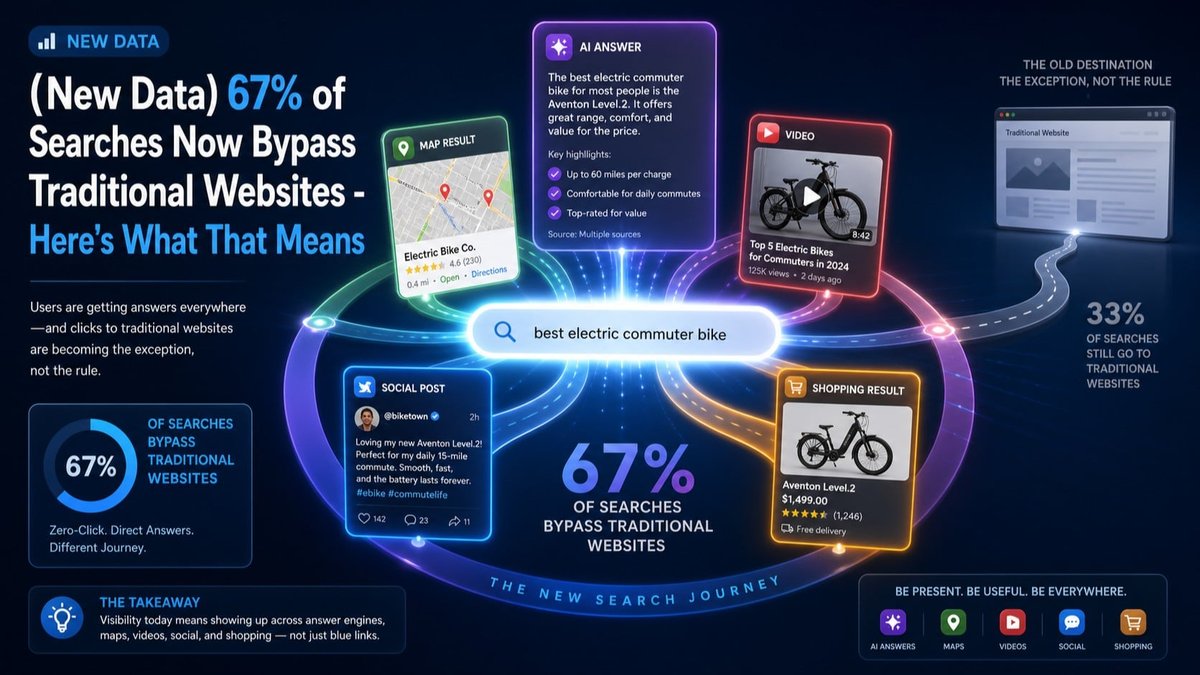
Profit Acuity has released new marketing data confirming that a significant majority of online searches now conclude without users clicking through to traditional websites. According to research from SparkToro and Similarweb analyzing clickstream data, 68.01% of U.S. Google searches ended without a single click during the first four months of 2026. Users increasingly find the information they need directly on results pages rather than navigating to individual sites, representing a fundamental shift in how people interact with search engines.
More information is available at Profit Acuity . The term "bypass" refers to mechanisms that deliver answers before users leave the search environment. AI summaries, featured snippets, knowledge panels, Google Business Profiles, local map packs, and platform results from YouTube or Reddit now serve information that previously required a website visit. The demand for information has not diminished; the journey has changed. Search engines and AI platforms provide immediate answers to factual queries, local searches, and shopping comparisons without requiring additional navigation.
Research from the Pew Research Center (2025) found that when AI summaries appear in search results, click-through rates to traditional links drop to just 8%, compared to 15% when no summary is displayed. Moz research suggests that AI Overviews could reduce organic traffic by 18% to 64% for websites providing straightforward informational content. Digital marketers can no longer rely solely on traditional click metrics to measure visibility and influence.
Digital marketers and SEO professionals must now optimize for both clicks and answers, ensuring their content appears across various search result formats and platforms. Answer-engine optimization has emerged as a strategy focused on creating structured, citable, and verifiable content that AI systems can accurately reference in summaries. Google Business Profiles have become necessary for local visibility. Google states that regularly updated Business Profiles receive five times more views, and some research indicates that up to 67% of "near-me" searchers contact businesses directly from search results. This evolution broadens the scope of SEO rather than replacing it, requiring professionals to think beyond the traditional ten-blue-links model.
Practical implementation varies by business type but follows common principles. Service businesses should prioritize Google Business Profiles, customer reviews, FAQ content, and structured data to shape first impressions before users reach their sites. Content publishers need tighter definitions, clear headings, and directly answerable content suitable for citation in AI summaries. E-commerce operations should focus on product feeds, customer reviews, and comparison content that helps users make decisions within the search environment. The goal is visibility wherever the search journey occurs: on a results page, within an AI interface, or across third-party platforms.
The marketing and SEO landscape has fundamentally shifted, requiring professionals to measure success beyond sessions and pageviews. Visibility in AI answers, map packs, and platform mentions now constitutes a critical component of the top-of-funnel strategy. Profit Acuity's data release provides digital marketers and SEO professionals with the evidence needed to understand the scope of this change and respond strategically, helping them adapt measurement frameworks and optimization approaches to reflect how users actually discover and evaluate information in 2026.
For more details, visit Profit Acuity