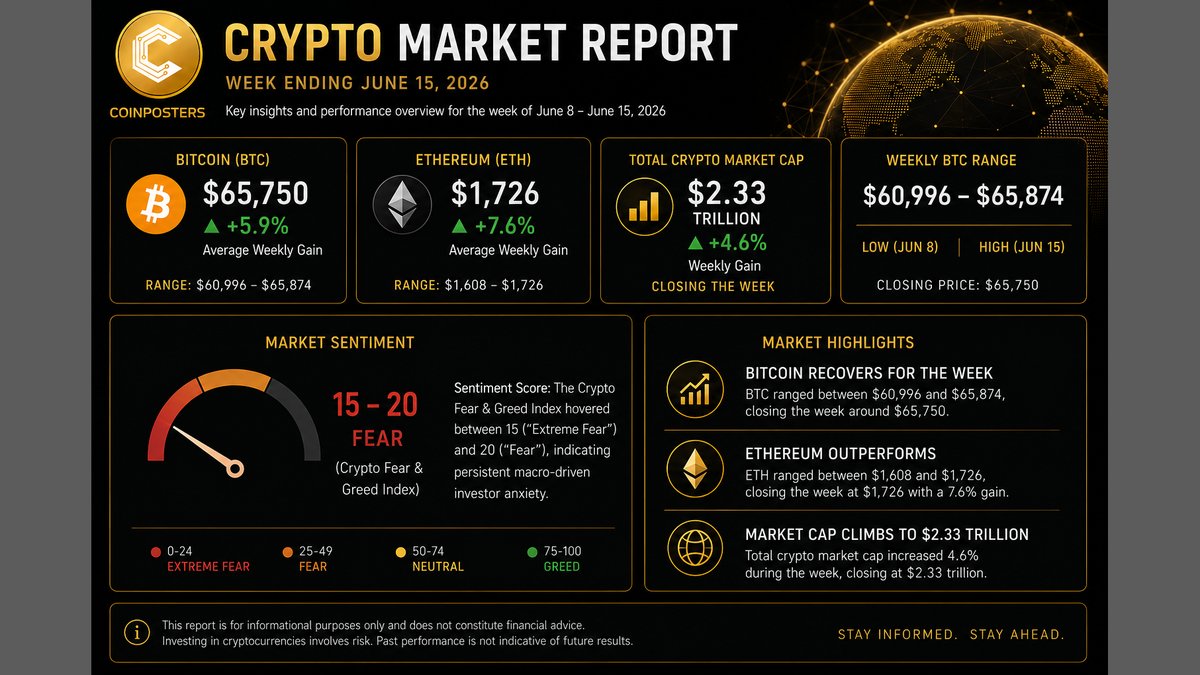
- Bitcoin's Puell Multiple is approaching the distress zone in early June 2026, flashing a stress signal that has historically preceded major price recoveries — but full capitulation is not confirmed until it crosses below 0.5.
- Miner capitulation has marked cycle bottoms multiple times before — in 2011, 2015, 2018, 2020, and 2022 — making the current on-chain readings a high-priority signal for investors watching cycle timing.
- Standard Chartered maintains long-term optimism regarding the crypto market, with analysts citing easing geopolitics, stabilizing ETF flows, and structural on-chain improvements as contributing factors.
- Bitcoin's RSI-14 fell into deep oversold territory on June 7 before recovering meaningfully by late June, suggesting the worst of the selling pressure may be behind the market.
- Miner distress is real and measurable right now, but disciplined investors are watching for one specific threshold before calling the definitive bottom — and that detail changes the entire risk calculus.
Something important is happening beneath the surface of Bitcoin's price chart in June 2026. While headlines focus on BTC reclaiming $65,000, the more telling story is unfolding in data that most investors never look at — miner profitability metrics, hash rate trends, and on-chain flow patterns that have a quiet but powerful track record of signaling where the market is headed next.
The Puell Multiple is approaching the distress zone. Hash rate is falling. Miner outflows to exchanges are rising. These are not random fluctuations. They are the same fingerprints that appeared before Bitcoin's most significant recoveries of the past decade. Understanding what is happening — and what still needs to happen — is the difference between reacting to price and actually anticipating it.
Puell Multiple Signals Miner Distress — But Full Capitulation Is Not Confirmed Yet
The Puell Multiple is sitting in compressed territory, with both the raw reading and its 30-day moving average signaling that miners are earning significantly less than their annual average. That condition forces less-efficient operations to sell BTC reserves just to keep the lights on. That forced selling adds market pressure, but it also sets the stage for what comes next.
Here is the nuance that matters: the classic capitulation zone for the Puell Multiple sits below 0.5. The current reading is firmly in the distress range but has not yet crossed the threshold that has reliably marked cycle lows in prior bear markets. That distinction is critical. Miner stress is confirmed. Full capitulation — the kind that historically clears the supply overhang and precedes sharp recoveries — is not yet confirmed.
Coinposters' weekly crypto market coverage has been tracking these on-chain signals in real time, giving investors the framework to interpret what these numbers actually mean for price direction. A Puell Multiple approaching the distress zone is a serious signal. A drop below 0.5 would be the alarm bell.
What Miner Capitulation Actually Means
Miner capitulation is the point where Bitcoin miners can no longer sustain operations without liquidating their BTC holdings. It is not a sentiment event — it is a financial one. When the cost of mining exceeds revenue, operators face a binary choice: sell Bitcoin reserves or shut down machines. The weakest, least-efficient miners exit first. Their selling creates temporary downward price pressure. But once they are gone, that supply source disappears entirely.
The mechanics create a self-resolving cycle. Capitulation brings selling pressure. That selling pressure drives prices down or keeps them suppressed. Eventually, the weakest hands are washed out. The miners who remain are operating profitably at current prices and have no reason to sell aggressively. Supply pressure drops. The market finds its footing.
Why the Halving Cycle Forces Miners to Sell
Bitcoin's halving mechanism cuts block rewards in half approximately every four years. The most recent halving reduced the per-block reward to 3.125 BTC. For miners running older, less-efficient hardware, that cut in revenue can be devastating — especially if Bitcoin's spot price has not risen enough to compensate.
Post-halving periods are historically the most dangerous for miner economics. Revenue drops immediately at the halving event. Operational costs — electricity, hardware maintenance, facility overhead — do not drop at all. The gap between revenue and cost widens. Miners who built their operations around pre-halving economics are suddenly underwater, and the only liquid asset they hold is Bitcoin. That is why halvings tend to trigger capitulation windows within months of the event, and why the current on-chain signals in June 2026 are tracking so closely to the post-halving playbook.
Hash Ribbons and the Puell Multiple: How to Read the Signals
Two indicators dominate serious miner capitulation analysis: the Hash Ribbons and the Puell Multiple.
Hash Ribbons track the 30-day and 60-day moving averages of Bitcoin's total network hash rate. When the 30-day MA crosses below the 60-day MA, it signals that mining capacity is being taken offline — a direct symptom of miners exiting the market. The crossover does not pinpoint the exact bottom, but it identifies the capitulation window with reasonable precision.
The Puell Multiple takes a different angle. It measures the ratio of daily Bitcoin issuance (miner revenue in USD) to the 365-day moving average of that same metric. When the ratio drops significantly below 1.0 — and especially when it falls below 0.5 — miners are earning far less than their historical average. Below 0.5 has historically been the zone where capitulation reaches its most acute phase, and where bottoms have formed. The current reading is approaching that zone without yet entering it.
Used together, these two indicators give a layered view of miner stress that neither provides alone. Hash Ribbons confirm that capacity is being removed from the network. The Puell Multiple quantifies how economically stressed the remaining miners actually are.
Multiple Times Capitulation Called the Bottom
Miner capitulation is not a theory. It has a documented track record across Bitcoin's most significant bear market recoveries. Each instance follows a similar pattern: profitability collapses, weak miners exit, selling pressure exhausts itself, and prices bottom.
2011, 2015, 2018, and 2020: The Earlier Playbooks
In 2011 and 2015, Bitcoin had been grinding lower following prior peaks. On-chain data in both periods reflected severe miner stress — hash rate growth had stalled and the Puell Multiple fell into deeply distressed territory, including below 0.5 in both cases. Those miner capitulation phases directly preceded Bitcoin's subsequent recoveries.
The 2018 pattern was sharper and faster. After Bitcoin's dramatic fall from nearly $20,000, the Q4 2018 collapse into the $3,000s was accompanied by one of the most acute miner capitulation events on record. Hash rate dropped significantly as entire mining farms went offline almost overnight. The Puell Multiple entered the sub-0.5 zone. Within weeks of those readings, Bitcoin's multi-year recovery began. The 2020 capitulation, triggered in part by the COVID-driven market crash, also saw the Puell Multiple fall below 0.5 before Bitcoin staged a powerful recovery into the 2021 bull run. Each instance followed the same mechanical logic: forced selling creates the bottom, exhausted sellers create the floor.
2022's $15K-$16K Bottom Confirmed by On-Chain Data
The 2022 bear market bottom is the most thoroughly documented capitulation event in Bitcoin's history, thanks to the maturity of on-chain analytics tools that now exist. When Bitcoin collapsed toward the $15,000-$16,000 range in November 2022 — following the FTX collapse — miner capitulation metrics fired simultaneously across multiple indicators.
The Puell Multiple dropped into the sub-0.5 zone. Hash Ribbons showed a confirmed 30-day/60-day crossover. Miner outflows to exchanges spiked to multi-month highs as operators were forced to liquidate holdings. Glassnode's on-chain analytics confirmed in real time that the selling pressure was being driven by miner stress, not just retail panic. The $15,000-$16,000 range proved to be the macro cycle low. Bitcoin subsequently recovered from those levels into the 2023-2024 bull run. The on-chain signals did not just reflect the bottom after the fact — they flagged the capitulation window as it was happening.
Bitcoin's June 2026 On-Chain Data, Decoded
The June 2026 on-chain data tells a coherent and internally consistent story. Multiple independent metrics are pointing in the same direction simultaneously — not because they are measuring the same thing, but because they are all capturing different dimensions of the same underlying stress event.
Puell Multiple Under Pressure and Approaching the Distress Zone
The Puell Multiple is currently in what analysts describe as the distress zone, reflecting a sustained compression in miner revenue that has been building for weeks. It has not yet breached the 0.5 threshold that has historically defined the most acute phase of capitulation, but the trajectory is pointing lower.
The significance of that 0.5 level is not arbitrary — it is derived from backtesting across every major Bitcoin bear market on record. When the Puell Multiple has dropped below 0.5, it has coincided with or immediately preceded macro cycle lows in each prior instance. The current reading places the market at the outer edge of the capitulation zone, with a clear directional signal that warrants close monitoring.
Hash Rate Drop and Miner Outflows to Exchanges
Hash rate has declined meaningfully in June 2026, indicating miner stress — a key component of the Hash Ribbons capitulation signal. This confirms that mining capacity is actively being taken offline. Less-efficient mining operations, unable to sustain profitability at current Bitcoin prices post-halving, are powering down machines rather than continuing to mine at a loss.
Simultaneously, miner outflows to exchanges are a critical metric to watch during periods of stress like this. When miners move Bitcoin from cold storage to exchange wallets, it is almost always a precursor to market selling rather than accumulation. The combination of declining hash rate and rising exchange inflows from miners — when confirmed — is a powerful signal that the capitulation process is underway, even if it has not yet reached its most extreme phase.
RSI-14 Fell Into Deep Oversold Territory in Early June Before Recovering
Bitcoin's 14-period Relative Strength Index fell into deep oversold territory on June 7, 2026 — well below the 30 level that signals aggressive selling beyond what typical momentum can sustain. Readings that low are rare even in bear markets, placing Bitcoin in extreme oversold territory on the daily chart.
By late June, the RSI-14 had recovered meaningfully — still below the neutral 50 level, but well off the oversold extreme. That recovery trajectory is constructive. It suggests the most intense selling pressure has passed without the RSI immediately rocketing into overbought territory, which would signal an unsustainable bounce rather than a genuine recovery. An RSI climbing steadily from extreme lows toward 50 — with price holding corresponding support levels — is exactly the pattern that precedes durable recoveries in prior cycles.
Standard Chartered's Long-Term Optimism on the Crypto Market
Standard Chartered's crypto research desk — one of the few institutional teams with a consistent track record of early and accurate cycle calls — maintains long-term optimism regarding the crypto market. Their analysts have cited a convergence of improving macro conditions, stabilizing Bitcoin ETF flows, and the structural resilience Bitcoin demonstrated by holding key support levels during the most intense selling pressure of early June as contributing factors to their positive outlook.
This is not a bank making a headline grab. Standard Chartered's crypto research history includes early 2023 price targets that were widely dismissed at the time and later proved accurate. Institutional allocators follow their research closely, and when a desk with that track record signals optimism, it tends to influence capital allocation decisions among the funds and family offices that read it. That institutional attention carries a momentum of its own — when allocators start treating the bottom as confirmed, re-entry flows begin, and that buying becomes part of what validates the call.
Headwinds Fading: How Geopolitical Uncertainty and ETF Flow Trends Are Shaping the Market
Two specific macro headwinds that had been suppressing Bitcoin through late May and early June 2026 have shown signs of easing. First, ongoing US-Iran negotiations have introduced some uncertainty around energy markets. Elevated energy prices feed inflation expectations, push rate cut timelines further out, and compress risk appetite across all asset classes — including crypto. Any meaningful de-escalation in that situation could remove a significant overhang from risk assets.
Second, spot Bitcoin ETF outflows — which had been running at elevated levels for several consecutive days, including single-day redemptions at historically significant levels — showed signs of easing in late June, with occasional modest inflows on some days, though overall net flows remained negative through much of the period. ETF flow data is one of the most direct real-time indicators of institutional sentiment available in crypto markets. A sustained shift from net negative to net positive flows would reflect a genuine change in how professional allocators are positioning — not retail sentiment reacting to price.
Together, a resolution of geopolitical uncertainty and a sustained reversal in ETF flows would create the macro conditions needed for on-chain fundamentals and technical oversold signals to translate into price recovery rather than simply continuing to get absorbed by macro selling pressure.
Does Capitulation Guarantee a Recovery? What Investors Should Know
Miner capitulation is one of the most historically reliable bottom signals in Bitcoin's on-chain toolkit — but historically reliable is not the same as guaranteed. The mechanism that makes capitulation meaningful is the exhaustion of forced selling: once miners who cannot sustain operations at current prices have exited and liquidated, that specific source of sell pressure disappears. The market structurally improves.
What capitulation does not account for is new sources of selling pressure that can emerge from outside the mining ecosystem. Macro deterioration, regulatory shocks, exchange collapses, or broader risk-off events can all extend bear markets even after miner capitulation signals have fired. The 2022 bottom, for example, required not just miner capitulation but also the full collapse of the FTX ecosystem before the market could finally find its floor. Capitulation was necessary but not sufficient on its own.
For investors, the practical framework is this: miner capitulation signals raise the probability that a significant low is near, but they do not eliminate downside risk. The appropriate response is not maximum risk-on deployment the moment capitulation signals appear — it is a systematic increase in position sizing as confirmation signals stack up. The Puell Multiple crossing below 0.5, hash rate stabilizing after a decline, and miner outflows to exchanges normalizing are the sequential confirmation steps that turn a probable bottom signal into an increasingly confirmed bottom thesis.
- Do not treat a single indicator as a standalone buy signal. Capitulation metrics are most powerful when they align with technical oversold readings and macro stabilization simultaneously.
- Watch for confirmation, not just the signal. A hash rate recovery after decline confirms the worst of the miner exit is over. That is the signal within the signal.
- Size positions to the probability, not the hope. If the Puell Multiple is approaching but not yet below 0.5, the probability of a bottom is rising — but it is not a certainty. Position sizing should reflect that.
Miner Distress Is Real — But Watch the Puell Multiple Cross 0.5 Before Calling the Bottom
Everything in June 2026's on-chain data points to a market under genuine miner stress. The Puell Multiple is deep in the distress zone. Hash rate has declined meaningfully, indicating a key component of the Hash Ribbons capitulation signal. The RSI-14 hit extreme oversold territory and is now recovering. Standard Chartered maintains long-term optimism on the crypto market. Geopolitical headwinds that were suppressing prices have shown signs of easing. The confluence of these signals is not random noise — it is a coherent picture of a market working through the late stages of a bear cycle.
But the one threshold that has most consistently marked actual macro bottoms in prior cycles — the Puell Multiple crossing below 0.5 — has not been breached yet. The market is approaching that level without confirming it. That distinction matters for how aggressively investors should be positioning right now versus building toward a more decisive entry.
The framework is clear: the signals are bullish, the trend is constructive, and the risk-reward for strategic accumulation is more favorable than it has been at any point in 2026. But the definitive confirmation that separates a probable bottom from a confirmed one is still one data point away. Watch the Puell Multiple. If it crosses below 0.5 and then begins recovering while hash rate stabilizes, the historical playbook from 2011, 2015, 2018, 2020, and 2022 says that entry window closes quickly.
The miner capitulation story in June 2026 is still being written — and the next chapter could be the most important one for Bitcoin's price trajectory heading into the second half of the year.
Stay current on every developing signal with Coinposters, where ongoing crypto market analysis helps investors track the on-chain data and macro developments that move prices before they move.