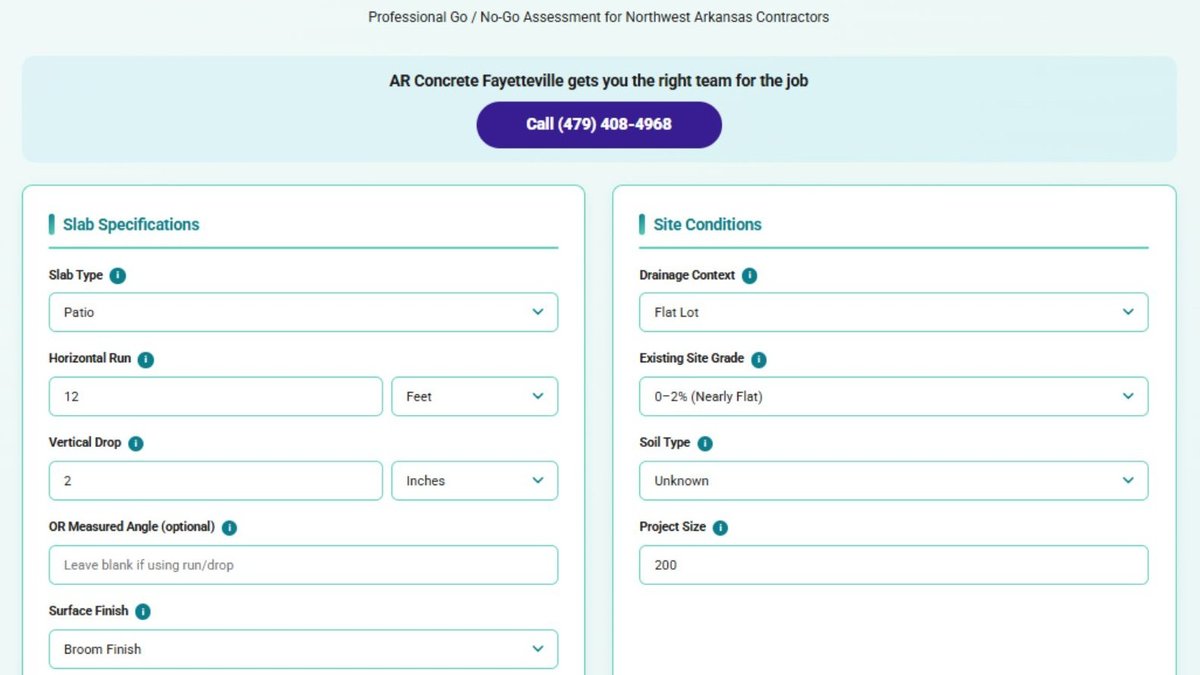
AR Concrete Fayetteville has introduced a specialized online calculator designed to help homeowners in the Fayetteville area assess potential concrete slab slope and drainage issues before committing to professional installation. The tool addresses regional challenges that make Northwest Arkansas particularly vulnerable to slab failures, including variable residual soils weathered from limestone, shale, and sandstone that can shift during seasonal wet and dry cycles, and frequent annual freeze-thaw cycles that cause surface scaling and spalling when water accumulates in low spots. The International Residential Code recommends a minimum 2% slope for impervious surfaces within 10 feet of building foundations to ensure proper water runoff, yet many homeowners lack the technical knowledge to evaluate whether their property meets this standard before investing in concrete work.
More information is available at https://blog.arconcretefayetteville.com/concrete-slab-slope-calculator/
Northwest Arkansas sits on the Ozark Plateau, where soils influenced by underlying limestone, chert, and sandstone formations vary significantly in depth and drainage capacity across individual properties. While the highly expansive Porters Creek Clay formation primarily affects south and central Arkansas, these residual, rock-derived soils across the Fayetteville region still require careful assessment before sloped concrete installations. These soil conditions, combined with the area's approximately 46 inches of annual precipitation and intense spring storms capable of dumping several inches in hours, create drainage pressures that can undermine improperly sloped slabs or generate hydrostatic pressure behind stemwalls. Homeowners who fail to account for these environmental factors during the planning phase often face costly repairs within months of installation, as differential settlement cracks concrete and water infiltration accelerates freeze-thaw damage.
The calculator serves as a preliminary assessment tool that helps property owners understand slope percentages and drainage considerations before requesting detailed professional evaluation. Homeowners can input basic measurements to determine whether their site falls within manageable ranges for standard slab installation or requires specialized approaches such as grading, stemwall foundations, or retaining walls. This self-assessment capability allows residents to make informed decisions about whether to proceed with concrete work and which solution pathway best fits their property conditions, potentially saving time and avoiding mismatched expectations when consulting with contractors.
Cost implications vary significantly based on slope severity. Mild slopes up to 10% may support grading approaches that cost $0.80-$2.00 per square foot for site preparation, while steeper slopes require stemwall solutions ranging from $6-$18 per square foot or retaining wall installations at $20-$55 per square foot for more complex designs. Early assessment through the calculator helps homeowners understand which cost category applies to their property, enabling more accurate budgeting and reducing the risk of discovering mid-project that initial plans were inadequate for site conditions.
AR Concrete Fayetteville has developed the calculator as part of a broader educational initiative that includes detailed blog content on slope installation techniques, cost breakdowns, and alternative solutions for challenging sites. The company's resources explain technical concepts such as low-slump concrete mixes that resist flowing downhill during placement, proper reinforcement spacing for sloped applications, and drainage system integration to protect against water-related foundation problems. By providing transparent information about both the challenges and solutions for sloped concrete work, the company positions itself as a resource for homeowners navigating complex installation decisions in an environment where local soil and climate conditions demand specialized expertise.
The calculator removes barriers to initial property assessment by allowing homeowners to evaluate their slope and drainage risk at no cost and with no obligation. Residents can access the tool on the company blog to determine whether their property presents mild, moderate, or severe challenges for concrete slab installation, then use that information to guide conversations with contractors about appropriate solutions. This approach builds homeowner confidence in the decision-making process while helping professionals focus consultation time on properties where concrete work is feasible and on recommending the most appropriate installation methods for specific site conditions.
Additional resources and professional consultation are available at https://arconcretefayetteville.com