Key Takeaways
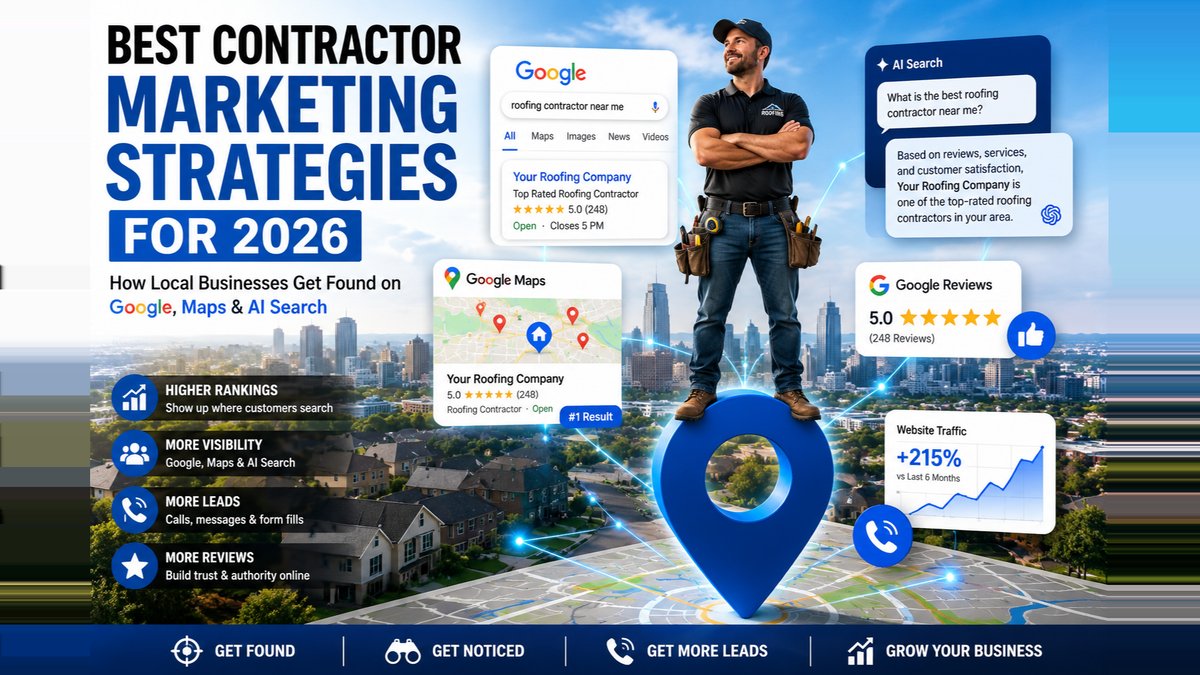
- Google's AI Overviews — powered by the Gemini model — are now selecting which local contractors get seen at the very top of search results, making citation in these overviews a top marketing priority for 2026.
- A fully optimized Google Business Profile, structured schema markup, and strong E-E-A-T signals are the three pillars that make AI Overviews more likely to cite your contracting business.
- Being cited in an AI Overview often delivers more visibility than ranking #1 organically — and the two goals can be pursued together.
- Newer disciplines like Generative Engine Optimization (GEO) and Answer Engine Optimization (AEO) are reshaping how contractors need to think about their online content — more on both below.
- Media Surge Marketing has been tracking these shifts closely, helping local contractors build the kind of optimized online presence that positions them for AI Overview citations in an increasingly competitive search environment.
Local contractors have spent years chasing page-one rankings. In 2026, the goalpost has moved — and the businesses that understand exactly where it moved will pull ahead of every competitor still playing by the old rules.
Google Controls Over 90% of Search — AI Overviews Now Decide Who Gets Seen
Google has held a commanding share of the global search market for over two decades, and that dominance isn't fading. What has changed, dramatically, is what happens at the very top of those search results. AI Overviews — Google's AI-generated summary boxes that appear before any organic listing — now answer many searches before a user ever scrolls down the page.
For contractors, this creates both a challenge and a significant opportunity. The challenge: if your business isn't cited inside one of those AI Overview boxes, a large share of searchers may never see your name. Industry data shows that nearly three out of four consumers turn to Google to find local services — which makes clear just how much is at stake when a single feature at the top of search results starts filtering who gets noticed and who gets skipped.
The opportunity is equally real. AI Overviews are still relatively new terrain — meaning contractors who move quickly to optimize for citation stand to gain a lasting advantage before the space gets crowded. Media Surge Marketing has been working directly with local service businesses to navigate exactly this shift, helping them build the kind of authoritative online presence that AI systems are most likely to reference.
AI Overviews Are Rewriting Local Search Rules
How Google's Gemini Model Selects Cited Sources
Google's AI Overviews are generated by its Gemini model, which synthesizes information from across the web to produce concise, direct answers. The model doesn't randomly pick sources — it favors content that is clear, authoritative, well-structured, and directly relevant to the query being asked.
For a roofing contractor, a plumber, or an HVAC technician, this means the question shifts from "How do I rank?" to "Why would Gemini trust my content enough to cite it?" The answer comes down to three things: how thoroughly your business information is presented across the web, how well your website content answers real customer questions, and how credibly your business signals expertise in its trade.
Gemini is especially attentive to structured, factual content. Pages that clearly state what a business does, where it operates, what customers say about it, and what specific problems it solves are far more likely to be surfaced in an AI Overview than pages with thin or generic copy.
Why Being Cited Beats Ranking #1 Alone
Traditional SEO chased the #1 organic ranking because it captured the most clicks. AI Overviews have disrupted that logic. When an AI-generated summary sits above all organic listings and directly answers a searcher's question, many users absorb the answer without ever clicking into the results below.
Being cited within the AI Overview box places your business in that high-attention zone — often with your business name, a snippet of your content, or a direct link. That kind of placement functions more like earned media than a standard search ranking, and its visibility often exceeds what a #1 organic position delivers on its own. The smart play for 2026 is to pursue both simultaneously: optimize for traditional rankings and create the kind of content AI Overviews are built to cite.
Your Google Business Profile Is the Starting Line
1. Complete Every Section — No Shortcuts
Google Business Profile (GBP) is the single most important free tool a contractor has for local search visibility — and it's still widely underutilized. A fully completed profile gives Google's AI systems a clean, reliable data source about your business, which directly supports citation in AI Overviews for local queries.
That means going beyond the basics. Fill in every available field: business category, service descriptions, service areas, hours of operation, phone number, website link, and photos. Write a meaningful business description that naturally includes the services you offer and the areas you serve. Use GBP's Posts feature to publish regular updates — job completions, seasonal offers, or tips for homeowners. Each completed field is another data point that signals to Gemini that your business is legitimate, active, and relevant.
2. Generate Reviews Consistently and Respond to Them
Reviews are one of the most powerful trust signals in local search — and they carry growing weight as AI systems assess business credibility. The best practice is straightforward: ask satisfied customers for a review immediately after a job is finished, when the experience is fresh and they're most likely to follow through.
Google provides a direct review link inside the GBP dashboard that can be texted, emailed, or printed as a QR code and left at the job site. Volume matters, but so does engagement — responding to every review, positive or negative, signals to Google that the business is attentive and professionally managed. That kind of active engagement builds the prominence factor Google weighs heavily in local rankings.
3. Distance, Relevance, and Prominence Still Drive Rankings
Google's core local ranking factors haven't disappeared — they've evolved. Distance (how close your business is to the searcher), relevance (how well your profile matches what they're searching for), and prominence (how well-known and trusted your business appears online) remain the three pillars of local map pack rankings.
What's changed is how AI Overviews interpret these factors. Comprehensiveness and authority now carry more weight than before. A contractor whose GBP is fully built out, whose website content is detailed and credible, and whose review profile is strong will increasingly find that these same qualities support AI Overview citation — because Gemini draws from the same signals Google's ranking algorithm values.
Schema Markup: Give AI a Cheat Sheet About Your Business
LocalBusiness, FAQ, and HowTo Schema for Contractors
Schema markup is code added to a website's backend that tells search engines — and AI systems — exactly what a page contains. Think of it as writing a structured briefing for Gemini: instead of requiring the AI to interpret your content and guess what it means, the schema explicitly states, "This is a local plumbing business, serving Austin, Texas, offering emergency pipe repair and water heater installation."
For contractors, three schema types are especially valuable:
- LocalBusiness schema — communicates your business name, address, phone number, service area, and hours directly to search engines in a machine-readable format.
- FAQ schema — marks up common customer questions and their answers, making that content highly accessible to AI Overviews looking for direct, concise responses to search queries.
- HowTo schema — ideal for process-driven content (e.g., "How to prepare your home for an HVAC replacement"), which AI systems frequently pull from when answering instructional queries.
Each of these schema types creates a clearer signal for Gemini and increases the likelihood that your content gets selected as a cited source. Google's Rich Results Testing Tool is a free resource for verifying that schema has been implemented correctly.
Schema-Rich Listings Significantly Outperform Bare Results on CTR
The practical difference schema makes is measurable. Service pages optimized with LocalBusiness and Service schema consistently show stronger performance in rich results — including increased exposure to potential AI Overview snippets. That kind of lift, achieved through a technical adjustment rather than a full content overhaul, illustrates why schema markup is a high-priority tactic for 2026.
Beyond AI Overviews, schema-rich listings are more likely to appear as enhanced results in standard organic search — with star ratings, service details, or FAQ dropdowns visible right on the search results page. These visual enhancements consistently attract more attention and clicks than plain blue links, making schema a dual-purpose investment in both AI visibility and traditional CTR.
E-E-A-T Separates Expert Contractors from the Noise
Certifications, Testimonials, and Original Content That Signal Authority
E-E-A-T stands for Experience, Expertise, Authoritativeness, and Trustworthiness — four qualities Google evaluates when assessing whether content is credible enough to rank well or be cited by its AI systems. As AI-generated content floods the web, these signals have become the primary filter separating genuine experts from generic noise.
For contractors, demonstrating E-E-A-T is less about abstract strategy and more about presenting real proof. That looks like:
- Certifications and licenses displayed prominently on service pages (e.g., NATE-certified HVAC technician, licensed master electrician).
- Customer testimonials and case studies that describe specific problems solved and outcomes delivered — not just generic five-star praise.
- Original, in-depth content written from genuine field experience — articles that explain why a particular repair approach works, what warning signs homeowners should watch for, or how to evaluate contractor bids — content that only someone with real expertise could write credibly.
Google's content guidelines are explicit: helpful, reliable, people-first content outperforms generic or AI-generated filler. For contractors, that means publishing content that genuinely serves homeowners and property managers — and making it unmistakably clear that it was written by someone who actually does the work. That combination of real-world experience and demonstrated expertise is precisely what Gemini is trained to recognize and cite.
GEO and AEO: The New Disciplines Contractors Can't Ignore
What Generative Engine Optimization Actually Means
Generative Engine Optimization — GEO — is the emerging practice of structuring online content specifically so that generative AI models, like the one powering Google's AI Overviews, can discover, understand, and cite it. It's a distinct discipline from traditional SEO, though the two overlap significantly.
Traditional SEO optimized content for algorithms that ranked pages. GEO optimizes content for AI systems that synthesize answers. The shift requires contractors to think differently about their web presence: not just "Does this page rank?" but "Would an AI model trust this page enough to quote it when someone asks a relevant question?"
GEO-focused tactics include writing content in clear, factual prose that answers specific questions, using structured formatting (headers, lists, short paragraphs) that AI models can parse easily, building authoritative citations and backlinks that signal trustworthiness to AI systems, and keeping business information consistent and thorough across every platform where the business appears online.
Answer-First Content That AI Overviews Pull From
Answer Engine Optimization (AEO) is a closely related concept — focused specifically on making content the best possible direct answer to a user's query. AI Overviews are, at their core, answer engines: they're built to deliver the clearest, most useful response to a search query without requiring the user to visit multiple websites.
Content that wins citations in AI Overviews tends to share a common structure: it leads with a direct answer, then expands with supporting detail. A page titled "How much does roof replacement cost in [City]?" that opens with a clear cost range, explains the key variables, and backs up the information with specific expertise is exactly the kind of content Gemini is designed to surface.
For contractors, this means auditing existing service pages and blog content with one question in mind: Does this answer a real customer question, directly and credibly, within the first few sentences? Pages that do are the ones most likely to earn an AI Overview citation — and the consistent traffic and trust that come with it.
In 2026, Cited Contractors Win — Start Optimizing Now
The search environment for local contractors in 2026 is not the same one that existed three years ago — or even one year ago. AI Overviews have introduced a new layer of competition at the very top of Google, and the contractors who treat citation as a core marketing objective will separate themselves from those still focused solely on traditional ranking tactics.
The strategies that drive AI Overview citations aren't exotic or out of reach. A fully built-out Google Business Profile. Schema markup that speaks AI's language. Content built around real expertise and direct answers. Reviews that demonstrate trust. E-E-A-T signals are woven through every page of the site. These are achievable, practical steps — and the contractors who execute them consistently will show up where it matters most.
The window to build this kind of competitive advantage is open right now, before AI Overview optimization becomes standard practice across the industry. Start with the Google Business Profile. Add schema markup. Audit content for answer-first structure. Each improvement compounds, and the cumulative effect is a web presence that AI systems are far more likely to cite, trust, and surface to the homeowners and property managers searching for exactly what your business offers.
For local contractors ready to put these strategies into practice, Media Surge Marketing specializes in helping local service businesses build the optimized online presence needed to compete — and win citations — in the era of AI-powered search.