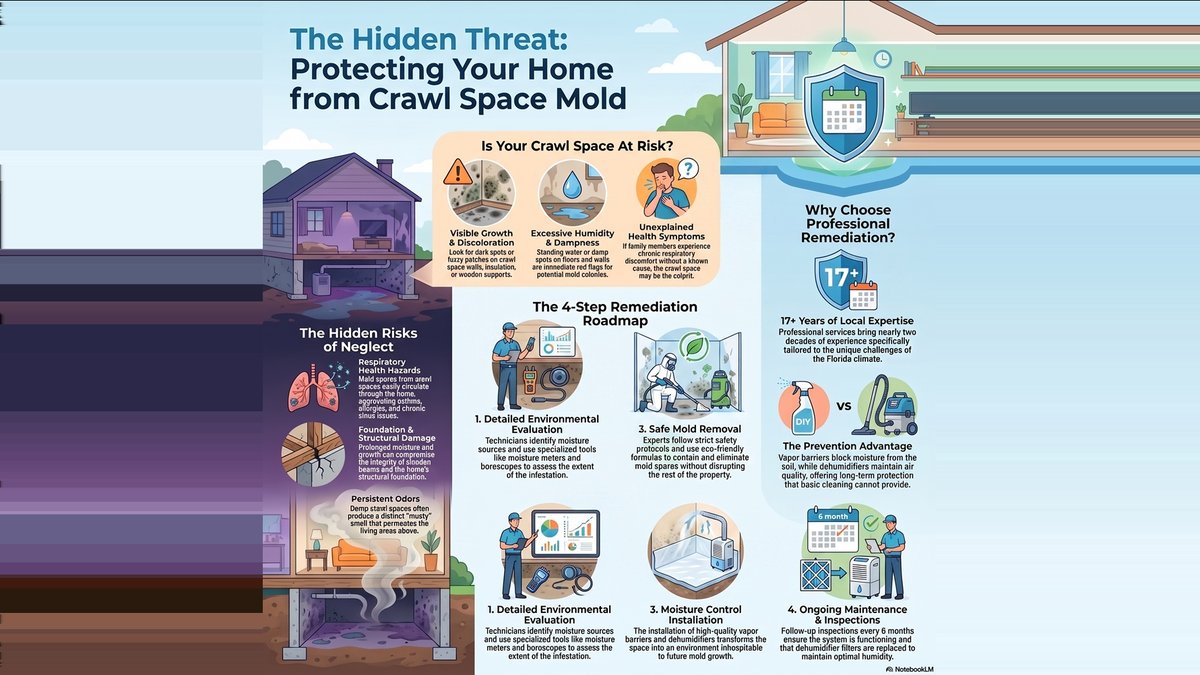
- Up to 50% of the air on your home's first floor originates from the crawl space - meaning a damp, moldy crawl space is directly affecting what your family breathes every day.
- Tampa Bay's subtropical heat, heavy rainfall, and high water table make crawl spaces one of the fastest mold-breeding environments in the country.
- The stack effect - a physics-driven process where warm air rising through your home pulls contaminated crawl space air upward - is why mold down below becomes a health problem up above.
- Opening crawl space vents in Tampa actually makes moisture problems worse, not better - a common mistake that costs homeowners thousands.
- Crawl space encapsulation is a highly effective long-term solution, and understanding what it involves and what it costs could save a home sale or prevent a serious health issue.
Most Tampa Bay homeowners never think about what's underneath their feet. The crawl space beneath a home quietly shapes the air quality inside it - every hour of every day. The connection between a damp crawl space and a family's respiratory health is more direct than most people realize, and in Florida's climate, the window between a dry crawl space and an actively moldy one is surprisingly small.
Up to 50% of Your Indoor Air Comes From the Crawl Space
Research indicates that as much as 40% to 50% of the air on the first floor of a home originates directly from the crawl space. That's not a leak or a fluke - it's a predictable result of basic building physics called the stack effect.
When a crawl space is damp and contaminated with mold, every breath taken on the first floor carries a fraction of that contaminated air. Mold spores, elevated humidity, and volatile organic compounds (VOCs) don't stay confined underground. They travel upward continuously through gaps in flooring, around plumbing penetrations, and through any unsealed opening between the crawl space and the living area above.
TampaBayMold.net, a licensed mold remediation specialist serving the Tampa Bay area, has documented this pattern consistently across crawl space inspections throughout the region. More detail on what that process looks like is available on their crawl space mold removal service page.
Why Tampa Bay Crawl Spaces Breed Mold Fast
Florida's climate doesn't just allow mold to grow - it actively accelerates it. Tampa Bay sits in a subtropical zone where conditions work against any crawl space left unmanaged.
Heat, Rain, and a High Water Table
The combination is relentless: high ambient outdoor humidity that rarely dips below uncomfortable levels, summer rainfalls that can dump several inches in an afternoon, and a water table shallow enough that moisture seeps upward through the soil beneath a home. Any one of these factors would create a challenging environment. Together, they create a near-constant source of moisture under the house - exactly what mold needs to colonize floor joists, vapor barriers, and wooden subfloor framing.
Condensation: The Hidden Trigger
Even on a dry day, condensation is a threat. When warm, humid outdoor air enters a crawl space and contacts the cooler underside of an air-conditioned home, moisture drops out of that air and settles on wood surfaces. Humidity levels above 60% are the critical threshold for mold proliferation - and in an unmanaged Tampa Bay crawl space, that threshold is crossed routinely, sometimes for months at a stretch without a homeowner ever knowing.
The Stack Effect: How Crawl Space Air Reaches You
The stack effect explains why a mold problem underneath a home doesn't stay underneath a home.
How Negative Pressure Pulls Air Upward
Warm air rises. As the air inside a home heats up and escapes through upper levels - through attic vents, gaps around light fixtures, or any high opening - it creates a zone of negative pressure in the lower portions of the building. That pressure imbalance must be equalized, and the home draws in replacement air from wherever it can find it. In a home with a crawl space, that means air is continuously being pulled upward from below.
The effect is strongest in winter when the temperature difference between inside and outside is greatest, but in Tampa Bay's mild winters and aggressively air-conditioned summers, the stack effect operates year-round. There is no season when crawl space air isn't being drawn into living spaces.
Health Consequences of Contaminated Air
When the air being pulled upward is laden with mold spores and excess humidity, the health consequences are real and well-documented. Reported effects include:
- Respiratory irritation and chronic coughing
- Allergy flare-ups, even in people without prior allergy diagnoses
- Worsening asthma symptoms
- Persistent fatigue and headaches with no clear cause
- Increased indoor humidity that drives secondary mold growth on walls and ceilings
Symptoms often get attributed to seasonal allergies or general illness - but when they improve during time away from home and return upon coming back, a contaminated crawl space is frequently the underlying cause.
Warning Signs You Should Not Ignore
Indoor Clues Without Going Underneath
Most homeowners won't crawl under their home, and they don't need to in order to recognize the warning signs. The following indoor signals suggest a crawl space problem is already affecting the living environment:
- A persistent musty smell, especially noticeable when the air conditioning kicks on
- Cupping, buckling, or soft spots in hardwood or laminate flooring
- Chronically high indoor humidity that makes the home feel sticky despite running the AC
- Unexplained allergy or asthma flare-ups that seem worse at home than elsewhere
- Visible mold on baseboards or lower walls, which often indicates a moisture source below
None of these symptoms require a crawl space inspection to notice - but all of them warrant one.
Opening Vents Makes Things Worse in Tampa
One of the most common and costly pieces of well-intentioned but wrong advice given to Tampa Bay homeowners is to open crawl space vents to "air things out." In a dry climate, venting can reduce moisture. In Tampa Bay, it does the opposite.
Because outdoor humidity in the Tampa Bay area is almost always high, opening crawl space vents simply pulls more moisture-laden outside air into the space. That humid air then hits the cooler surfaces beneath the air-conditioned home, condenses, and feeds the very mold problem the homeowner was trying to fix. Sealed crawl spaces consistently outperform vented ones in Florida's climate - a fact that runs counter to older building codes but is now well-supported by field data.
Encapsulation: The Long-Term Fix
Mold remediation cleans up what's already grown. Encapsulation is what prevents it from coming back.
What Encapsulation Actually Involves
A properly executed crawl space encapsulation in a Tampa Bay home involves several coordinated steps:
- Sealing all crawl space vents to prevent humid outdoor air from entering
- Installing a heavy-duty vapor barrier (typically 8-20 mil polyethylene) across the ground and up the walls to block ground moisture
- Installing a commercial-grade dehumidifier sized for the crawl space volume - standard residential units aren't sufficient for Florida's moisture load
- Addressing any existing mold through remediation before sealing, so contamination isn't locked in
The result is a controlled, conditioned space that no longer cycles through the humidity fluctuations that fuel mold growth.
Air Quality and Energy Savings
The benefits extend well beyond mold prevention. Homes with encapsulated crawl spaces consistently show significant improvement in airborne pollutant levels. Energy efficiency improves too - regulating the humidity and temperature beneath the home reduces the load on the HVAC system, with some homeowners reporting utility bill reductions of up to 20%. Wood rot slows dramatically, preserving the structural integrity of floor joists and the home's foundation over the long term.
What Remediation Costs - and What Insurance Won't Cover
Crawl space mold removal typically ranges from $2,500 to $6,000, depending on the size of the space and the severity of the infestation, though local pricing in the Tampa Bay area may vary. If structural wood has rotted and needs replacement, or if full encapsulation is added, total project costs can typically reach $7,000 to $15,000 or more, though local pricing in the Tampa Bay area may vary.
Florida law requires professional licensing for mold assessment and remediation on areas exceeding 10 square feet. The state also mandates that the mold assessor and the remediator be separate entities - a safeguard against conflicts of interest that homeowners should verify when hiring any contractor.
On the insurance side, the answer is almost always discouraging: most standard Florida homeowners policies exclude mold damage unless it results directly from a covered peril like a burst pipe. Mold caused by chronic humidity, poor ventilation, or groundwater intrusion is typically classified as a maintenance issue - meaning the cost falls entirely on the homeowner. Addressing the problem before it becomes severe is significantly cheaper than waiting.
A Moldy Crawl Space Can Kill Your Home Sale
For homeowners thinking about selling, a crawl space problem won't quietly pass a home inspection. Mold, standing water, or rotting joists beneath a Tampa Bay home are among the most serious red flags a buyer's inspector can flag. Buyers routinely demand full remediation and encapsulation before closing - and when the cost estimate arrives, many simply walk away from the deal entirely.
Proactively addressing a crawl space before listing is far less painful than a deal falling through after a contract is already signed.
Tampa Bay Homes Need Encapsulation, Not a Wait-and-See Approach
In most of the country, a crawl space with a little moisture is a minor inconvenience. In Tampa Bay, it's an active risk - to health, to the structure of the home, and to its resale value. The stack effect ensures that what happens in the crawl space doesn't stay in the crawl space. Given Florida's relentless heat and humidity, the gap between "slightly damp" and "actively moldy" closes faster than homeowners expect.
Encapsulation is the baseline standard for any Tampa Bay home with a crawl space - not an optional upgrade for the overly cautious. Waiting for visible signs of a serious problem means the problem has already been affecting indoor air quality for months, possibly years.
For Tampa Bay homeowners ready to take the crawl space seriously, TampaBayMold.net provides licensed crawl space mold remediation and encapsulation services throughout the region.