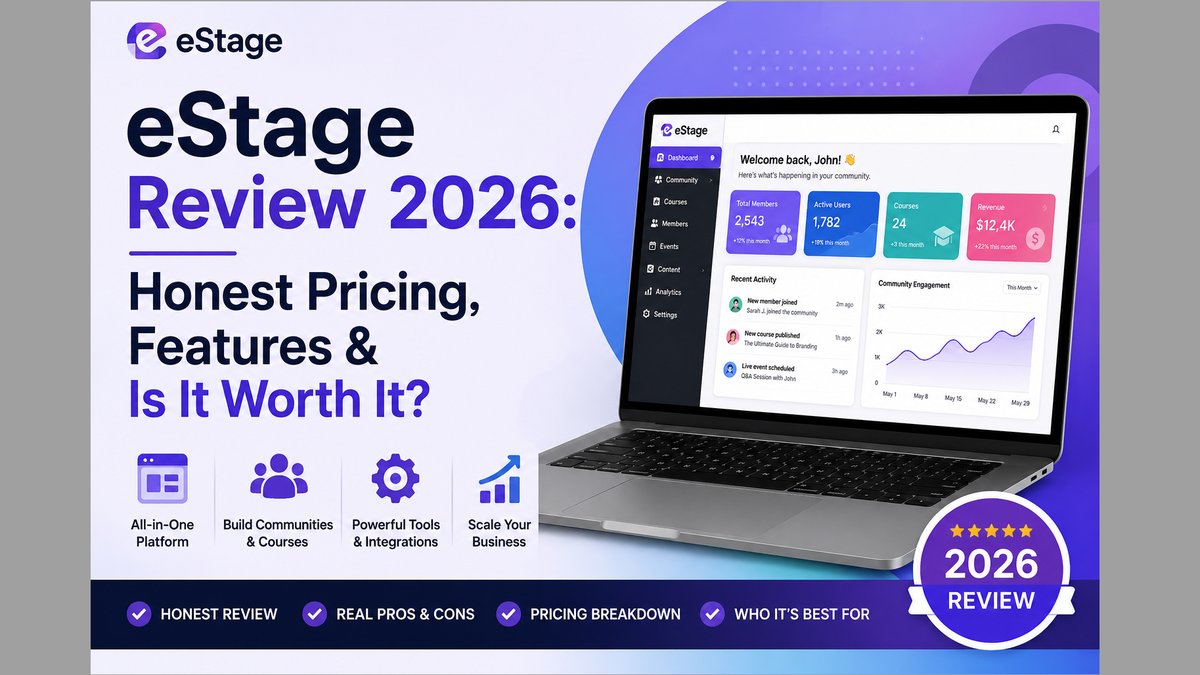
Key Takeaways
- The average small business utilizes over 100 separate software tools, with some studies indicating up to 172 apps for businesses with 500 or fewer employees — a problem known as "tool sprawl" that quietly kills productivity and profits.
- Constant app-switching costs entrepreneurs up to 40% of their productive time, while fragmented data creates a broken customer experience.
- eStage takes a hub-centric approach, consolidating websites, funnels, CRM, courses, live streaming, and community tools into a single platform — replacing the need for tools like Kajabi, ClickFunnels, and HubSpot.
- All-in-one consolidation isn't a new idea — HubSpot, Salesforce, and Notion already proved the model works at scale.
- There are real trade-offs to consider before switching, including premium pricing and migration complexity — both covered in detail below.
Running an online business in 2026 means making dozens of micro-decisions every day — and a surprising number of them have nothing to do with the actual business. They're about which tool to log into, where a contact's data lives, and why the funnel isn't talking to the email platform. It's a quiet drain that most entrepreneurs don't notice until they add it all up.
Many Small Businesses Juggle Dozens of Disconnected Software Platforms — And It Shows
Industry data puts the average small business at over 100 software tools, with some studies reporting up to 172 apps for businesses with 500 or fewer employees. That's a staggering number — a different login for the website, another for email marketing, one for the CRM, one for course hosting, another for community management, and so on. Each tool was probably chosen because it was the best option at the time. Together, they form what's known as tool sprawl: a tangled web of subscriptions, integrations, and workflows that nobody deliberately designed.
The visible cost is the monthly bill. But the hidden cost is much larger — in fragmented customer data, broken automation chains, duplicated effort, and the mental load of managing it all. For online entrepreneurs trying to scale, this isn't a minor inconvenience. It's a structural problem that compounds over time.
Tool Sprawl Is Quietly Draining Entrepreneurs
Up to 40% of Productive Time Lost to App-Switching
Productivity research consistently points to context-switching as one of the most underestimated costs in modern work. Switching between disconnected applications — checking a CRM, jumping to a funnel builder, pulling up an email platform, then back to a community tool — doesn't just take time. It breaks focus. And broken focus is expensive.
Productivity reports suggest that up to 40% of productive time is lost to this kind of constant app-switching. For a solo entrepreneur or small team, that's not an abstract percentage. That's hours every week that could go toward creating content, closing deals, or building systems — redirected instead toward tool management and tab navigation.
The compounding effect is real. Every new integration added to a stack is another potential point of failure, another support ticket waiting to happen, and another layer of complexity sitting between an entrepreneur and the work that actually moves the business forward.
Fragmented Data Means a Broken Customer Journey
When tools don't share a common data layer, customer information gets scattered. A lead captured through a funnel builder might not sync cleanly with the CRM. A course purchase might not trigger the right community access. An email sequence might fire without knowing a customer already converted.
This fragmentation doesn't just create operational headaches — it creates a broken customer experience. Customers receive irrelevant messages, hit dead ends in their journey, or simply fall through the gaps between platforms. From a business perspective, that means lost revenue and eroded trust, often without a clear audit trail pointing to the cause.
Unified platforms address this directly. When all business data — contacts, purchases, content consumption, engagement history — lives in one system, every touchpoint in the customer journey can be informed by the full picture. That's the operational argument for consolidation, and it's a strong one.
What Makes eStage a Hub — Not Just Another Builder
There's no shortage of platforms claiming to be "all-in-one." Most of them are funnel builders with bolt-on features, or course platforms that added a landing page tool as an afterthought. The distinction matters, because a collection of loosely connected features isn't the same thing as a genuinely integrated system.
A full breakdown of how eStage approaches this architecture is available at this independent eStage review, which covers the platform's structure, feature set, and real trade-offs in detail.
One URL, One Login, One Shared Data Layer
The defining characteristic of eStage's hub model is that everything operates from a single domain, a single dashboard, and a single data layer. A visitor who lands on a blog post, clicks into a funnel, purchases a course, and joins a community — all of that happens under one roof, tracked in one place.
This isn't just a convenience feature. It fundamentally changes what's possible in terms of automation and personalization. When a platform knows the full context of a customer relationship — not just a slice of it pulled from an API — the business can respond intelligently at every stage. That's the practical difference between a hub and a stack of tools pretending to be one.
Designed to Consolidate Tools Like Kajabi, ClickFunnels, and HubSpot Into One System
Independent reviewers have noted that eStage is specifically architected to replace the combination of tools that most online entrepreneurs are currently paying for separately. The comparison list typically includes Kajabi for courses and memberships, ClickFunnels for funnel building, and HubSpot for CRM — three platforms that together can run well over $500 per month, and still require integrations to function as a cohesive unit.
eStage brings those capabilities into a single system, meaning no third-party integrations to maintain, no data handoff issues between platforms, and no separate support queues for each tool. For entrepreneurs who've been running this kind of multi-platform stack, the consolidation case is straightforward.
Core Features Inside the eStage Platform
Rather than listing capabilities in a vacuum, it's worth framing what each feature actually solves — because that's what separates useful platform architecture from a long spec sheet.
1. Visual Hub Builder — No Code Required
eStage's drag-and-drop hub builder is designed for entrepreneurs, not developers. The visual interface allows for the creation of full websites, landing pages, and branded environments without touching a line of code. Independent reviews describe the UI as notably cleaner and more modern than legacy builders like ClickFunnels or the WordPress page-builder ecosystem — a meaningful distinction when the final product needs to reflect a premium brand.
2. Smart Funnels for High-Converting Customer Journeys
The platform's funnel architecture goes beyond static page sequences. Smart funnels within eStage are designed to guide visitors through a conversion-optimized journey that responds to behavior and context — not just a linear click-through. Because funnels share the same data layer as the rest of the hub, the transition from visitor to lead to customer to community member happens without handoff gaps.
3. Integrated CRM — Contacts Live Where Your Business Does
One of the most practical consolidations eStage offers is CRM built directly into the platform. Contact management, interaction history, and customer segmentation all exist inside the same dashboard where content, products, and community live. This eliminates the most common friction point in multi-tool stacks: the CRM that never quite syncs right with everything else.
4. Gated Areas and Course Hosting Under One Roof
Course creators and membership site operators typically need a dedicated LMS platform — or a complex set of plugins — just to lock content behind a paywall and manage student access. eStage handles gated areas and course hosting natively, meaning curriculum, student management, and sales automation are all connected without a third-party learning management system in the mix.
5. Live Streaming Built Directly Into Your Hub
Live events are one of the highest-engagement formats in digital business — and also one of the messiest to manage across a fragmented stack. eStage integrates live streaming directly into the hub, so entrepreneurs can broadcast to their audience in the same environment where their products, community, and content already exist. No separate streaming tool, no redirect to an external platform, no broken experience for the viewer.
6. Hub Analytics for Data-Driven Decisions
Because all activity flows through a single system, eStage's analytics can surface insights that siloed tools simply can't. Visitor behavior, funnel drop-off points, content engagement, and conversion data all live in one place — giving entrepreneurs a complete picture of what's working and what isn't, without manually stitching together reports from five different dashboards.
How eStage Stacks Up Against the Competition
Hub-Centric vs. Funnel-Focused vs. Community-Only Platforms
Most online business platforms are built around a single core use case and expand from there. ClickFunnels is, at its core, a funnel builder — everything else is additive. Skool is built around community — courses and discussions are the center of gravity. Kajabi leans into course and membership hosting with marketing tools layered on top.
eStage takes a different architectural stance. The hub is the product — a central branded environment that owns the domain, the data, and the entire customer relationship. Funnels, courses, CRM, community, and live streaming are all features of that hub, rather than the hub being a feature of one of those things. That's a meaningful distinction for entrepreneurs building long-term brands rather than running individual campaigns.
Where ClickFunnels, Kajabi, and WordPress Fall Short
Each of these platforms has genuine strengths — but they also have structural limitations that become more apparent as a business grows:
- ClickFunnels excels at funnel construction but lacks native community, live streaming, and strong CRM functionality. Connecting those capabilities requires third-party tools, which reintroduces the integration problem.
- Kajabi offers a more complete package for course creators but is less flexible for entrepreneurs who need full website control, custom hub architecture, or live-event capabilities built into the same environment.
- WordPress offers near-unlimited flexibility but at a significant cost in setup complexity, plugin maintenance, security overhead, and technical knowledge requirements. It's a platform that rewards developers more than entrepreneurs.
None of these are bad tools in isolation. The problem is that no single one of them covers the full scope of what a growing online business needs — which is exactly the gap eStage is designed to fill.
Real Trade-Offs to Know Before Switching
Any honest evaluation of a platform includes the downsides — and eStage has a few worth understanding clearly before making a decision.
Premium Pricing Isn't for Every Budget
eStage is positioned as a premium platform, and the pricing reflects that. For entrepreneurs who are just getting started or are operating on a tight budget, the entry cost may be a barrier. The value proposition — replacing multiple subscriptions with one — is most compelling for businesses already paying for the tools eStage consolidates. For someone who hasn't yet built out that stack, the upfront cost comparison looks different.
The honest framing: eStage makes the most financial sense for entrepreneurs who are currently spending $300-$600+ per month across multiple tools and are feeling the operational cost of managing them. For hobbyists or early-stage builders, other options may be a better fit to start.
Migration and the Platform Lock-In Reality
Consolidating an entire business into one platform is a significant commitment — and that cuts both ways. The efficiency gains are real, but so is the dependency. Moving an established business off a deeply integrated platform at a later date is a substantial project, regardless of which all-in-one platform is involved.
This isn't unique to eStage — it's a structural reality of any consolidated system. HubSpot users face the same consideration. So do Kajabi users. The key is entering the decision with clear eyes: consolidation trades integration complexity for migration complexity. Whether that trade is worth it depends entirely on the entrepreneur's current situation and long-term trajectory.
All-in-One Consolidation Works — HubSpot, Salesforce, and Notion Already Proved It
The skepticism around all-in-one platforms is understandable — the promise of "one tool to replace them all" has been made and broken many times. But at the enterprise and mid-market level, the consolidation model has already been validated at scale.
HubSpot built an entire category around inbound marketing by unifying content, CRM, email, and analytics into one platform — and used that integration to reduce churn and increase customer lifetime value. Salesforce pioneered the cloud-based CRM model and then expanded into a full business ecosystem, demonstrating that subscription-based consolidation could replace on-premise complexity. Notion proved there was massive demand for a single flexible workspace that could replace Evernote, Confluence, Trello, and Google Docs simultaneously — not by being the best at any one thing, but by being connected across all of them.
The pattern is consistent: when consolidation is done well, the integration itself becomes the competitive advantage. The whole becomes more valuable than the sum of its parts. That's the underlying logic eStage is applying to the online entrepreneur market — a space that has historically been dominated by point solutions rather than unified platforms.
For Entrepreneurs Done Duct-Taping Tools Together, eStage Makes the Case for Centralization
The case for a hub-centric platform isn't built on any single feature — it's built on the compounding cost of not having one. Every disconnected tool adds friction. Every integration is a liability. Every month of paying for five platforms that don't fully communicate is a month of running a business at a structural disadvantage.
eStage's architecture — one URL, one login, one shared data layer, with websites, funnels, CRM, courses, community, and live streaming all operating as parts of a connected whole — is a direct response to that problem. It won't be the right fit for every entrepreneur at every stage. The premium pricing is real, the migration commitment is real, and the learning curve for those coming from other platforms deserves honest acknowledgment.
But for online entrepreneurs who've already built a multi-tool stack and are feeling its weight — in their monthly bills, their working hours, and their customer experience — the centralization argument is compelling. HubSpot, Salesforce, and Notion didn't just build popular products. They built platforms that made fragmentation feel unnecessary. That's the standard eStage is aiming for in the online business space.
For deeper coverage of online business platforms, tool consolidation strategies, and what entrepreneurs are actually building with in 2026, Saaswired covers the SaaS landscape with independent analysis built for online entrepreneurs.