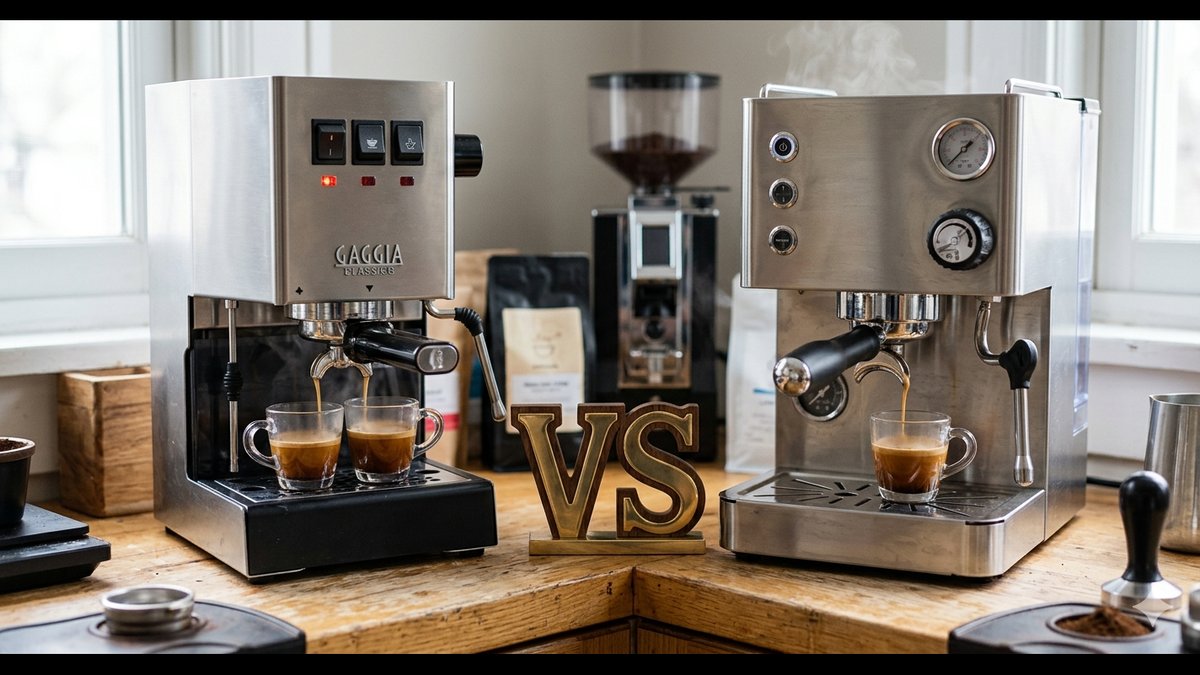
BrewPrecision has released a comparative evaluation of the Gaggia Classic Pro E24 and Turin Legato V2 espresso machines, addressing a purchasing paradox that has confused home baristas evaluating equipment in the $439 to $599 range. Despite a modest price difference of $20 to $160 depending on retailer and sales timing (prices fluctuate — current figures should be verified before purchasing), the two machines serve fundamentally different buyer profiles, according to the analysis. The evaluation clarifies why this gap exists and what justifies the cost for consumers weighing purchases in the $200 to $1,000 segment.
More details can be found at https://brewprecision.com/articles/gaggia-classic-pro-vs-turin-legato-thermal-mass-vs-digital-control
The price difference reflects divergent architectural philosophies rather than a simple hierarchy of quality. The Gaggia Classic Pro E24 employs a single-boiler, dual-use design with a 1,330-gram lead-free brass boiler, mechanical bimetallic thermostats, and standardized parts availability spanning over 30 years. In contrast, the Turin Legato V2 features a hybrid dual-heat configuration combining a 550-milliliter stainless steel brew boiler with an independent steam thermoblock, managed by dual PID controllers. According to in-puck temperature testing conducted by Whole Latte Love, the E24 maintains a 3°F temperature variance during extraction, an improvement over the roughly 7°F range Whole Latte Love measured on aluminum-boiler Evo Pro models, while the Legato eliminates manual temperature surfing entirely through digital feedback loops. These architectural choices drive the cost justification: convenience comes with trade-offs in repairability and longevity.
Daily workflow differences between the two platforms are substantial. The Gaggia requires 10 to 15 minutes of heat-up time for full thermal saturation, manual temperature surfing to establish consistent starting temperatures, and roughly a minute to reach steam readiness, followed by a manual priming sequence to refill and cool the boiler. The Legato reaches display readiness in 3 to 5 minutes, eliminates temperature surfing through PID automation, and transitions from brewing to steaming almost instantly without cool-down requirements. While these conveniences improve shot-to-shot consistency and reduce friction for beginners, they introduce complexity through electronic control boards and digital components that are sensitive to heat and moisture.
Long-term reliability concerns reveal hidden costs associated with the lower upfront price of the Legato. Some buyers report reliability concerns typical of imported OEM machines, including out-of-the-box failures and electronic component issues, according to customer reviews. Spare parts availability is severely limited for the Legato, which is sourced as an OEM product from China under various brand names, potentially rendering the machine difficult to repair after its one-year warranty expires. In contrast, the Gaggia benefits from a 30-year legacy of standardized parts, with every gasket, switch, solenoid, and boiler widely available from dozens of retailers.
The Gaggia's mechanical simplicity unlocks long-term value through extensive modding potential. Owners can install PID kits ranging from $100 to $300 to eliminate temperature surfing, or pursue advanced microcontroller modifications such as Gaggiuino or Gaggimate, which add pressure and flow profiling capabilities comparable to prosumer machines costing over $3,000. The Legato, by contrast, has minimal aftermarket support and virtually no modding community, as its feature-complete design removes the incentive for community-driven development. BrewPrecision frames this distinction as the core value question: the Gaggia serves as a platform for long-term investment and customization, while the Legato functions as a feature-rich appliance with a finite lifespan.
BrewPrecision's recommendations are explicit. Beginners prioritizing immediate convenience and plug-and-play workflow should consider the Legato, while long-term investors and technical hobbyists seeking mechanical longevity, food-safe metallurgy, and modding potential should opt for the E24. The price gap reflects alignment with buyer values: immediate usability versus mechanical durability, repairability, and upgrade pathways, rather than one machine being objectively superior. The full evaluation and expanded guidance are available at the company's website.
For more information, visit https://brewprecision.com