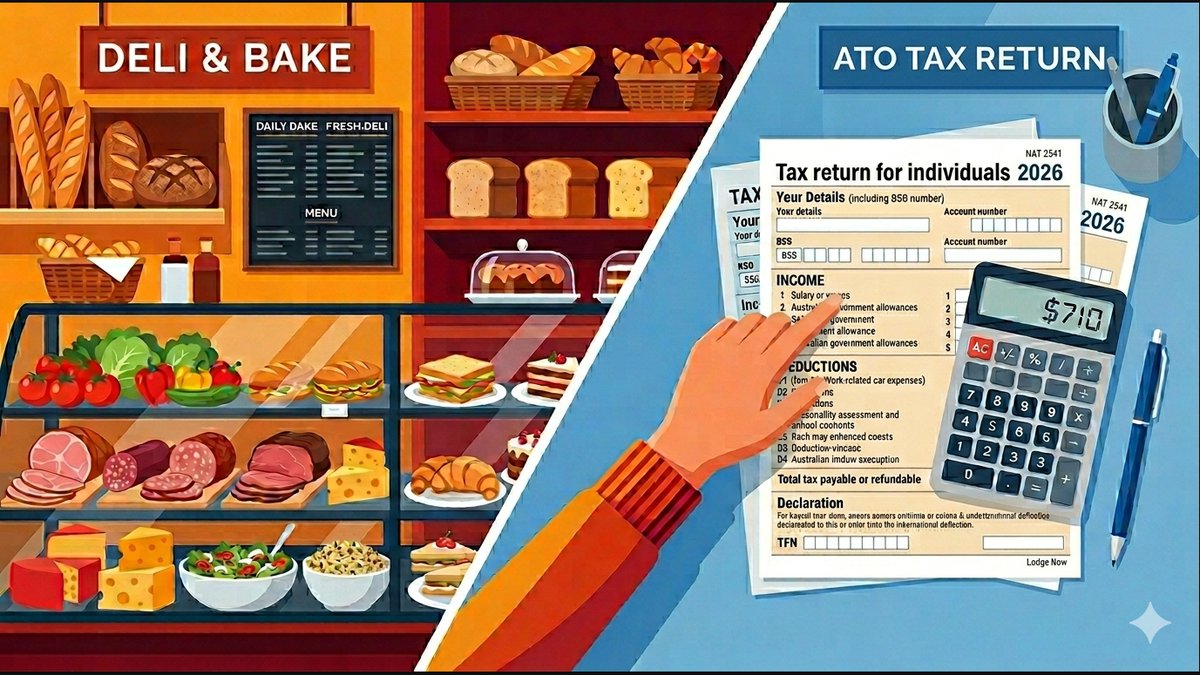
Taxrates.info announces the release of Tax Determination TD 2025/7, published by the Australian Tax Office (ATO) on 22 October 2025, which sets updated values for goods taken from stock for personal use during the 2025-26 financial year. The determination provides new GST-exclusive amounts that Australian small business owners in specific industries—including bakeries, butcher shops, licensed and unlicensed restaurants and cafés, caterers, delicatessens, fruiterers and greengrocers, takeaway food outlets, and mixed businesses such as milk bars and convenience stores—must add to their taxable income when trading stock is transferred to personal use.
More information is available at https://atotaxrates.info/businesses/goods-taken-from-stock-for-own-use/
Australian small business owners operating as sole traders or partnerships in the specified industries face a mandatory compliance obligation: when trading stock is withdrawn for personal consumption, the ATO requires that it be accounted for as if the goods had been sold. This regulatory requirement means the value of goods taken must be included in assessable income, directly increasing taxable income and affecting overall tax liability. The ATO publishes these annual schedules to simplify compliance for small businesses that might otherwise struggle with detailed valuation and record-keeping, offering a standardised approach that reduces administrative burden while ensuring tax obligations are met.
The 2025-26 schedule reflects CPI-adjusted increases across the nominated business categories compared to the previous financial year. For bakeries, the GST-exclusive value per adult or child over 16 years has risen from $1,580 in 2024-25 to $1,620, while the amount for children aged 4 to 16 increased from $790 to $810. Licensed restaurants and cafés now report $5,460 per adult or child over 16 and $2,210 for younger children, up from $5,310 and $2,150 respectively. Butchers must account for $1,070 per adult or child over 16 and $535 for children aged 4 to 16, compared to $1,040 and $520 in the prior year. These updated figures provide business owners with information they can apply immediately when preparing tax returns and business activity statements.
Business owners have two compliance pathways: they may elect to use the ATO's published amounts or maintain detailed records of the actual value of goods taken for private use. To apply the schedule, proprietors multiply the number of adults and children over 16 in their household by the relevant per-person value, then add the product of children aged 4 to 16 and the corresponding amount. Taxrates.info provides an interactive calculator that automates this process, allowing users to select their financial year and business type to generate the total value excluding GST. For businesses registered for GST, the schedule values exclude the tax component; GST-inclusive amounts must be calculated separately and reported in business activity statements, as the transaction is treated as a taxable sale. The calculator also provides the GST-inclusive amount.
The ATO derives these values from Household Expenditure Survey data published by the Australian Bureau of Statistics, which the office adjusts annually to reflect Consumer Price Index movements. This evidence-based methodology ensures the amounts represent current costs and consumption patterns across Australian households. The industries included in the schedule share common characteristics: they involve manual transformation of trading stock, such as baking or butchering; they handle a range of small, low-value items or ingredients; they experience high turnover, often involving cash transactions; and they are not well-suited to detailed inventory tracking systems, making standardised values both practical and appropriate for compliance purposes.
Taxrates.info offers Australian small business owners a resource hub for the 2025-26 goods taken from stock requirements. The website features the complete updated schedule, year-on-year comparison tables spanning from 2024-25 to 2025-26, an interactive calculator for determining household-specific values, and detailed guidance on record-keeping obligations and GST implications for registered businesses. Prior-year schedules dating back to 2010-11 are also available for reference, supporting business owners who need historical data for amendments or comparative analysis. These tools enable proprietors to ensure compliance and optimise their tax return preparation for the current financial year.
For more details, visit https://taxrates.info