Key Takeaways
- Mirror angles between 18° and 90° determine the exact number and type of symmetrical patterns visible in kaleidoscopes through precise mathematical formulas
- Brewster's original patent specified 18°, 20°, and 22.5° as the most pleasing angles, while his treatise recommended 30°, 36°, and 45° for optimal beauty
- Perfect symmetrical patterns emerge when mirror angles are even divisors of 360°, creating classic effects like hexagonal six-point stars at 60° and square patterns at 90°
- Advanced multi-mirror systems and innovative designs like Steve Gray's groundbreaking Parasol mirror arrangement push traditional kaleidoscope boundaries beyond simple two-mirror configurations
- Mirror quality and precise placement amplify the visual impact of specific angles, making the difference between stunning clarity and disappointing results
The mesmerizing dance of light and color inside a kaleidoscope isn't magical—it's mathematical precision at work. Every symmetrical pattern, from delicate six-pointed stars to bold geometric crosses, emerges from the exact angle between mirrors. Understanding these relationships unlocks the secret to creating breathtaking kaleidoscope designs that captivate viewers with their perfect symmetry.
Mirror Angles Create Specific Symmetrical Patterns Through Mathematical Precision
The relationship between mirror angles and kaleidoscope patterns follows strict mathematical principles that determine exactly what viewers see. When light enters a kaleidoscope, it bounces between angled mirrors, creating multiple reflections that form symmetrical designs. The angle between these mirrors controls how many times an image reflects, directly influencing the final pattern's structure and visual impact.
This mathematical foundation explains why certain angles produce consistently beautiful results while others create chaotic or incomplete patterns. Each degree of mirror adjustment fundamentally alters the viewing experience, transforming simple colored objects into complex, symmetrical masterpieces. The precision required demonstrates why kaleidoscope artistry combines both scientific understanding and creative vision.
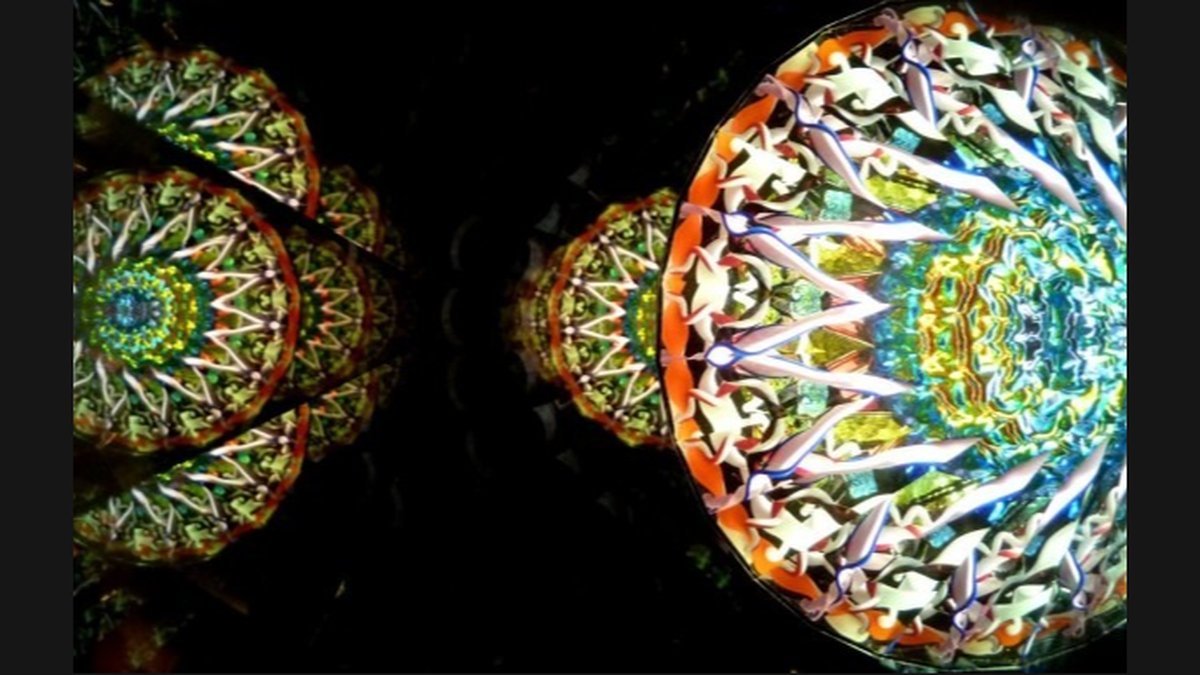
Modern kaleidoscope artists like Steve Gray have built upon these mathematical principles to create innovative designs that push traditional boundaries. His "Reflections of a Parasol" design demonstrates how understanding mirror mathematics enables artists to develop entirely new viewing experiences that maintain perfect symmetry while offering fresh perspectives.
Brewster's Patent and Treatise Recommendations for Optimal Mirror Angles
David Brewster, the kaleidoscope's inventor, identified specific mirror angles through extensive experimentation in the early 1800s. His 1817 patent specified that 18°, 20°, and 22.5° produced the most pleasing visual effects, creating high numbers of reflections that generated intricate, detailed patterns. These narrow angles multiply images many times, resulting in complex designs that fill the entire viewing field with delicate symmetrical elements.
18°, 20°, and 22.5° Patent Angles for Most Pleasing Effects
Brewster's original patent angles create some of the most visually striking kaleidoscope patterns due to their high reflection counts. An 18° angle produces 19 reflections (360° ÷ 18° - 1 = 19), creating incredibly detailed patterns with numerous image repetitions. The 20° angle generates 17 reflections, while 22.5° creates 15 reflections, each offering slightly different visual densities and complexities.
These patent angles work particularly well because they are even divisors of 360°, resulting in complete, symmetrical patterns with a high number of reflections that can appear intricately detailed. However, the high number of reflections requires extremely precise mirror alignment and high-quality reflective surfaces to maintain image clarity across all repetitions.
30°, 36°, and 45° Treatise Examples for Creating Optimal Beauty
In his later treatise, Brewster recommended wider angles—30°, 36°, and 45°—for creating what he termed "optimal beauty." These angles produce fewer but more distinct reflections: 30° creates 11 reflections, 36° produces 9 reflections, and 45° generates 7 reflections. The reduced reflection count makes individual pattern elements more prominent and easier to distinguish.
These treatise angles offer practical advantages for kaleidoscope construction. Fewer reflections mean less light loss between mirrors, resulting in brighter, more vibrant images. The wider angles also prove more forgiving during construction, as slight alignment variations have less dramatic effects on the final pattern quality.
The Mathematics Behind Mirror Angles and Pattern Formation
The mathematical relationship governing kaleidoscope patterns follows a simple but precise formula: the number of reflections equals 360° divided by the mirror angle, minus one. This formula determines exactly how many times an object appears in the final pattern, directly controlling the visual complexity and symmetrical structure viewers observe.
360° Division Formula Determines Reflection Count
The 360° division formula provides the foundation for predicting kaleidoscope patterns before construction begins. For example, a 60° mirror angle produces 5 reflections (360° ÷ 60° - 1 = 5), creating the classic six-element pattern when including the original object. A 90° angle yields 3 reflections, resulting in four-element patterns that form squares or crosses.
This mathematical predictability allows kaleidoscope designers to plan specific visual effects with precision. Artists can calculate exactly how many pattern elements will appear and how they'll arrange themselves around the viewing circle, enabling deliberate design choices rather than random experimentation.
Even Divisors of 360° Create Perfect Symmetrical Patterns
Angles that divide evenly into 360° produce the most satisfying symmetrical patterns because they create complete, balanced designs without partial elements. Common even divisors include 60° (6 divisions), 45° (8 divisions), 36° (10 divisions), and 30° (12 divisions). These angles ensure that pattern elements distribute evenly around the viewing circle.
Perfect symmetrical patterns appeal to viewers because they satisfy the brain's preference for order and balance. Even divisor angles eliminate visual tension caused by incomplete or asymmetrical elements, creating harmonious designs that feel naturally pleasing and mathematically complete.
Non-Divisor Angles Produce Fractional or Broken Image Parts
Mirror angles that don't divide evenly into 360° create patterns with fractional elements or incomplete reflections around the circle's edge. While these "broken" patterns might seem flawed, they often produce intriguing visual effects with overlapping elements and complex asymmetries that some viewers find more dynamic than perfect symmetry.
Artists sometimes deliberately choose non-divisor angles to create unique visual effects. These angles can produce patterns with overlapping elements and shifting focal points that change as objects move within the kaleidoscope, offering more varied and unpredictable viewing experiences than mathematically perfect designs.
Common Kaleidoscope Angles and Their Distinctive Patterns
Specific mirror angles produce signature patterns that kaleidoscope enthusiasts easily recognize. Understanding these common angles and their characteristic effects helps both creators and collectors appreciate the deliberate choices behind different kaleidoscope designs and their intended visual impact.
60° Creates Classic Hexagonal Six-Point Stars
The 60° mirror angle stands as perhaps the most recognizable kaleidoscope configuration, producing elegant six-point star patterns that form perfect hexagons. This angle creates 5 reflections plus the original object, arranging six identical elements in a circular pattern that naturally pleases the human eye with its balanced proportions.
Hexagonal patterns at 60° work exceptionally well because they mirror natural structures found throughout nature, from snowflakes to honeycomb cells. This biological familiarity makes 60° patterns feel inherently comfortable and beautiful to viewers, explaining why many traditional kaleidoscopes use this classic angle.
90° Produces Four-Fold Square and Cross Shapes
Mirror angles of 90° create bold, geometric patterns with strong four-fold symmetry that forms squares, crosses, or diamond shapes. This perpendicular mirror arrangement produces 3 reflections plus the original, creating patterns with clear geometric structure and strong visual impact that appeals to viewers who prefer architectural or crystalline aesthetics.
The 90° angle offers practical construction advantages because perpendicular mirrors are easier to align precisely than angled configurations. Right-angle mirror systems also maximize light efficiency since the perpendicular arrangement minimizes light loss between reflections, resulting in bright, sharp images even with complex object arrangements.
45° and 36° Generate Eight and Ten-Point Patterns
Mirror angles of 45° create sophisticated eight-point patterns with 7 reflections plus the original object, while 36° angles produce ten-point designs with 9 reflections. These higher-element-count patterns offer more visual complexity than simpler four or six-point designs, creating intricate mandala-like effects that reward close examination.
Both 45° and 36° angles strike an effective balance between pattern complexity and visual clarity. Eight and ten-point patterns provide enough elements for rich detail without becoming visually overwhelming, making them popular choices for kaleidoscopes intended for extended viewing sessions or meditative use.
Advanced Multi-Mirror Systems and Polycentral Designs
Beyond traditional two-mirror kaleidoscopes, advanced multi-mirror systems create entirely new categories of visual experiences. These sophisticated arrangements use three or more mirrors in complex configurations that produce infinite repeating patterns and revolutionary viewing perspectives that push kaleidoscope artistry into new territory.
Three-Mirror Triangular Arrangements at 60°
Brewster's "Polycentral Kaleidoscope" used three reflectors at 60° angles, creating an infinite field of repeating triangular patterns that fill the entire viewing area without gaps or empty spaces. The mathematical precision of the 60° triangular arrangement ensures perfect tessellation across the visual field.
Three-mirror systems produce "uncommonly splendid" effects, as Brewster described them, because they eliminate the dark spaces typically found at pattern edges in two-mirror systems. The infinite repetition creates immersive viewing experiences where patterns seem to extend beyond the kaleidoscope's physical boundaries.
Steve Gray's Groundbreaking Parasol Mirror System Innovation
Contemporary kaleidoscope artist Steve Gray developed an innovative "Parasol" mirror system that approaches pattern creation from an entirely new perspective. Gray's innovative design creates cascading mandala effects with exceptional depth.
Gray's Parasol system demonstrates how modern innovations build upon historical mathematical principles while creating unprecedented visual experiences. The system incorporates innovative elements, combined with advanced lighting and object cells, producing three-dimensional effects that push beyond traditional kaleidoscope capabilities.
Mirror Quality and Placement Amplify Angle Effects on Pattern Clarity
Even perfect mirror angles cannot compensate for poor mirror quality or imprecise placement. The flatness, reflectivity, and alignment of mirrors directly impact pattern sharpness and brilliance. High-quality mirrors with excellent reflectivity preserve image clarity through multiple reflections, while inferior mirrors create dim, distorted patterns regardless of their angular precision.
Mirror placement accuracy becomes increasingly critical with smaller angles that produce numerous reflections. Tiny alignment errors compound through multiple reflections, causing pattern elements to appear blurred or misaligned. Professional kaleidoscope makers use precision fixtures and measurement tools to ensure mirror positioning meets the exacting standards required for optimal pattern formation.
Master Mirror Angles to Design Your Own Stunning Kaleidoscope Patterns
Understanding the mathematical relationships between mirror angles and pattern formation empowers both collectors and creators to make informed decisions about kaleidoscope designs. Whether selecting a kaleidoscope for personal enjoyment or planning a custom creation, knowledge of these principles ensures the final result matches the intended visual experience.
Successful kaleidoscope design begins with choosing mirror angles that support the desired aesthetic goals. Simple, bold patterns benefit from wider angles like 60° or 90°, while complex, detailed effects require narrower angles like 18° or 22.5°. Consider lighting requirements, construction complexity, and intended use when making these foundational decisions that will determine the kaleidoscope's character.
Experimentation within mathematical frameworks leads to the most rewarding results. Start with proven angle combinations from Brewster's recommendations, then explore variations that push boundaries while maintaining the mathematical precision necessary for beautiful symmetrical patterns. Remember that the most stunning kaleidoscopes combine technical excellence with artistic vision, using mirror angle mathematics as the foundation for creative expression.