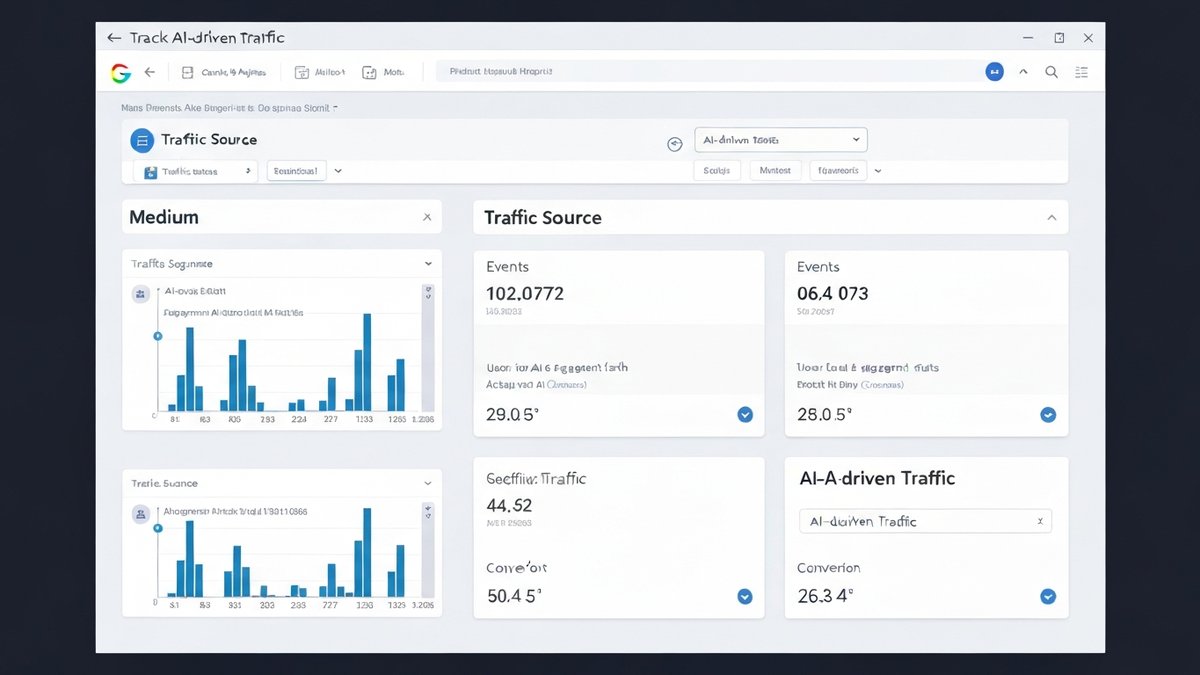
AI-driven website traffic has grown substantially over the past year, with visitors from AI platforms spending more time on sites compared to organic search visitors, according to multiple industry reports. Digital marketers and web analysts face a measurement challenge: Google Analytics 4 lacks native tools to fully identify and segment this traffic. Profit Acuity has released a GA4-focused guide that enables marketers to address this gap through custom channel groups and regex-based filtering, providing a practical workflow to isolate, analyze, and optimize user behavior originating from AI tools such as ChatGPT, Perplexity, Gemini, Copilot, and Claude.
More details can be found at https://profitacuity.com
The business case for tracking AI traffic is strong. AI visitors show higher engagement rates than many traditional channels, while industry benchmarks reveal that visitors from AI referrals often convert during their first session at rates exceeding organic search. Revenue per visit from AI traffic has increased significantly according to Adobe's tracking across retail sites. These metrics indicate that AI traffic represents a high-intent, high-converting source that marketers should measure and attribute accurately.
While Google introduced a dedicated 'AI Assistant' traffic channel in May 2025 to automatically recognize inbound traffic from supported large language models, full tracking still requires custom solutions. Traffic from platforms like Perplexity often lands in the 'Referral' category, and Google's AI Overviews are counted as 'Organic Search,' meaning marketers relying on standard GA4 reports miss significant AI traffic. The guide from Profit Acuity addresses this limitation by offering a repeatable workflow that marketers can implement immediately to gain full visibility into AI-sourced visits.
The guide walks users through a regex-based filtering methodology designed to identify AI referrers across multiple platforms. Marketers learn how to use Explorations and custom reports to filter sessions using a common regex pattern: (chatgpt|openai|anthropic|deepseek|grok)\.com|(gemini|bard)\.google\.com|(perplexity|claude)\.ai|(copilot\.microsoft|edgeservices\.bing)\.com|edge\scopilot. By applying this pattern to dimensions such as session source and page referrer, analysts can segment AI traffic cleanly and create a dedicated custom channel group labeled 'AI Tools' or 'AI Chatbots,' ensuring accurate attribution and comparison against other traffic channels.
Once AI traffic is properly segmented and visible in standard GA4 reports, marketers gain actionable insights that drive optimization. They can identify which landing pages and content pieces appear most frequently in AI tool responses, compare AI conversion rates and engagement against other channels, and build funnels and path analysis specific to AI visitors. This visibility enables data-driven decisions about which pages deserve optimization for AI citation, which content prompts align with user intent, and how to allocate budget toward high-performing AI sources.
The guide is now available to digital marketers and web analysts through Profit Acuity's platform. As AI-driven traffic continues to grow and reshape online behavior, marketers must evolve their analytics strategies to measure and optimize this channel effectively. For more information and to access the guide, visit https://profitacuity.com