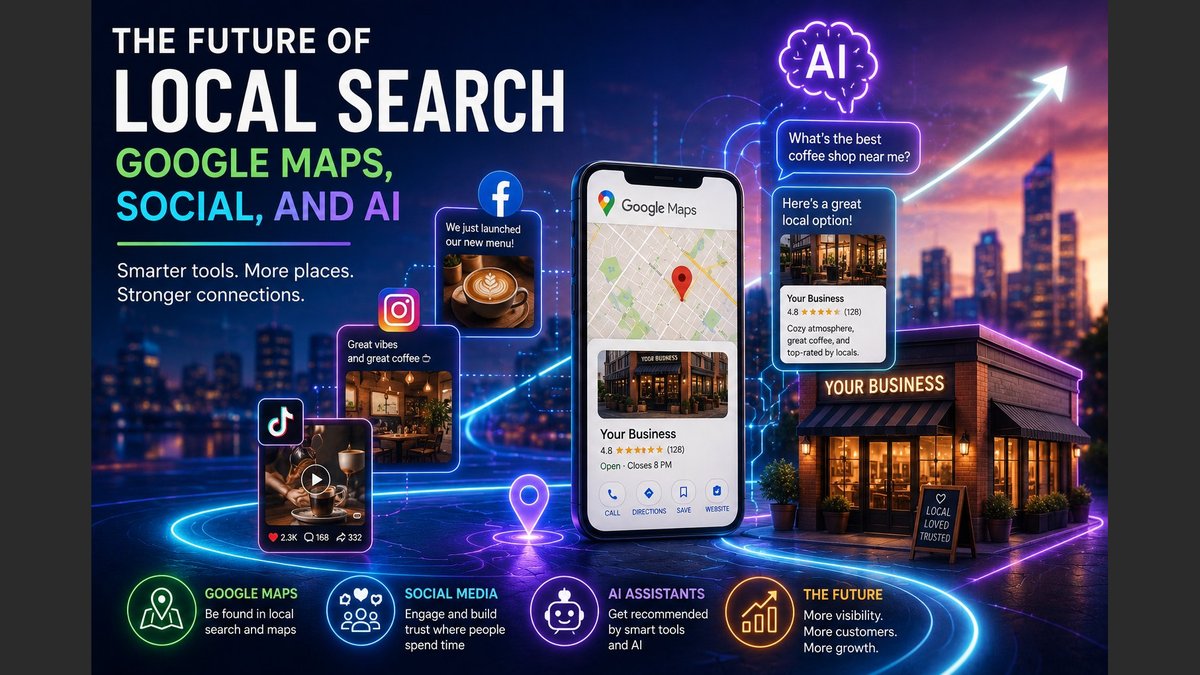
Profit Acuity announced findings from its 2026 local search report, stating that the way consumers find businesses has changed fundamentally. Local search has moved from a ranked list of ten results to a system where AI tools, voice assistants, and Google's AI Overviews name only a handful of businesses directly. For a local business owner, that shift changes what it takes to get found, since being fourth on a list no longer earns even a mention.
For more details, visit The Future of Local Search - Google, Maps, AI
The report notes that Google remains where more than half of consumers begin their local search, as a study cited in the report demonstrates. Even when consumers start elsewhere, 71% still touch Google at some point during their search. That pattern suggests Google increasingly functions as a verification step, confirming details a consumer already found somewhere else rather than serving only as a starting point.
That verification behavior fits inside a larger pattern of multi-channel search. Research cited in the report found that 75% of consumers used more than one platform during a single search session, moving between Google, Maps, social media, and AI tools before deciding who to call. A business visible on only one channel covers a single stop in what has become a multi-stop search process, and missing the rest can mean losing the customer to a competitor who shows up everywhere the search touches.
What determines which businesses actually surface across these channels comes down largely to Google Business Profile data, the company explains. AI systems extract profile fields, review text, photos, and connected website content to decide whether a business qualifies for a named mention, and an incomplete or outdated profile risks exclusion regardless of how established the business is offline.
That risk is magnified by how quickly AI Overviews have replaced older search formats. A Whitespark study found that AI Overviews now appear for 68% of local searches, compared with just 39% for traditional local packs. That gap illustrates how fast AI-generated summaries have become a primary way many consumers receive local business recommendations, ahead of the map-based listings businesses have relied on for years.
Underlying all of it is a simpler requirement: consistent Name, Address, and Phone Number data, commonly shortened to NAP consistency, across every platform where a business appears. AI systems treat mismatched information as a signal of uncertainty and tend to favor businesses they can verify without conflict. Profit Acuity built its Precision Profit Plan around this kind of measurement, using more than 500 data points to build a 12-month revenue roadmap before recommending any spend, then billing most of the resulting work on performance. Local business owners can request a Precision Profit Plan to assess how their business appears across search, video, social, and AI before competitors close the gap.
More information about Profit Acuity is available at https://profitacuity.com/authority-content-system/