Key Takeaways
- Renuvion and Morpheus8 both use radiofrequency energy to tighten skin, but they work at different depths - Renuvion contracts tissue beneath the skin, while Morpheus8 remodels it from the surface down.
- The degree of skin laxity is the single most important factor in choosing between the two procedures - mild cases may respond well to either, while moderate laxity often calls for Renuvion's deeper mechanism.
- Neither treatment replaces a surgical facelift for severe or advanced sagging - understanding where that threshold sits can save time, money, and unrealistic expectations.
- At Lydian Cosmetic Surgery Clinic in Seoul, each treatment plan is stated to be built around a thorough assessment of facial anatomy, skin thickness, and laxity grade before any procedure is recommended.
Non-surgical facial tightening has come a long way. Patient demand for these procedures continues to grow, with Renuvion and Morpheus8 among the most sought-after options for non-surgical facial tightening. They share some surface-level similarities, but the way each one delivers energy - and the skin conditions each one is built for - are meaningfully different.
Two RF Treatments, One Key Difference: Where Energy Is Delivered
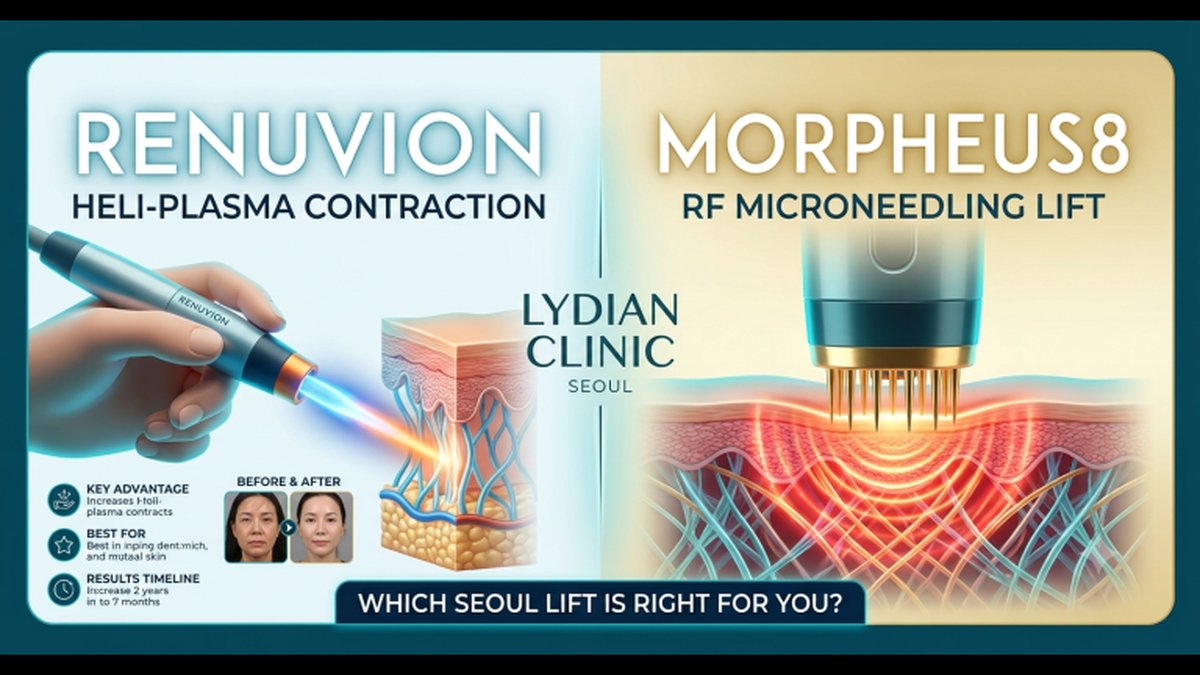
Both Renuvion and Morpheus8 use radiofrequency (RF) energy to heat tissue, trigger collagen remodeling, and firm sagging skin. The real distinction is the entry point and depth of delivery. Renuvion works entirely beneath the skin through small access points, targeting the connective tissue framework that physically supports facial structure. Morpheus8 approaches from the outside, driving insulated microneedles through the skin's surface to reach the dermis and select sub-dermal layers. Same energy source, completely different anatomical targets - and that difference determines which treatment is appropriate for which patient.
How Renuvion Contracts Tissue from Beneath the Skin
Helium Plasma + RF: The Sub-Dermal Mechanism
Renuvion - also known clinically as J-Plasma - is minimally invasive by design. A slim handpiece is inserted beneath the dermis through tiny micro-incisions, typically placed in discreet locations. Once positioned, the device combines radiofrequency energy with cold helium gas, which ionizes into a precise plasma beam. This beam rapidly heats the Fibroseptal Network (FSN) - the connective scaffolding anchoring skin to deeper facial structures - to approximately 80°C for a fraction of a second. The helium gas simultaneously cools the surrounding area, protecting adjacent tissue from thermal spread.
Because the energy never has to penetrate through the epidermis to reach its target, Renuvion can act directly on the structural layer responsible for support and definition. This is a meaningful mechanical advantage when the primary concern is loose tissue rather than surface texture.
Immediate Collagen Contraction
The thermal burst causes immediate contraction of collagen fibers, with some clinical descriptions citing significant fiber-level contraction at the treatment zone. This is followed by progressive neocollagenesis over three to six months as the body rebuilds new collagen. Patients often notice a visible firming effect once post-procedure swelling clears, with continued structural improvement developing well after that initial phase.
How Morpheus8 Remodels from the Surface Down
Fractional RF Microneedling: Depth and Precision
Morpheus8 uses an array of ultra-fine, gold-plated microneedles that penetrate the skin at customizable depths - ranging from 1mm for superficial dermal work up to 4mm for sub-dermal targeting on facial applications. As the needles reach their set depth, pulsed RF energy is discharged into the surrounding tissue, creating controlled micro-lesions in the reticular dermis and, at deeper settings, reaching into subcutaneous fat. The fractional delivery means only a portion of the skin is treated per pass, leaving surrounding tissue intact to support healing.
This approach lets a single treatment session address multiple skin layers simultaneously, making Morpheus8 well-suited to patients whose concerns span both laxity and skin quality.
Collagen Stimulation Over Multiple Sessions
Morpheus8 does not produce immediate mechanical contraction the way Renuvion does. Results build progressively. Initial improvements in skin texture can appear as early as three days after treatment, but the meaningful structural firming - driven by new collagen formation - takes three to four weeks per session to surface. Most protocols call for three to four sessions spaced four to six weeks apart, with peak results visible after the full series.
The Laxity Threshold That Separates Them
Mild to Moderate: Morpheus8's Sweet Spot
Morpheus8 performs at its best when laxity is early and surface concerns are part of the picture. Patients with mild jawline softening, fine lines around the mouth and eyes, enlarged pores, acne scarring, or early neck looseness are well-matched to what RF microneedling delivers. It improves both firmness and skin quality - a practical combination for patients who want gradual rejuvenation with minimal disruption. The cheeks, lower face, under-eye area, and neck all respond well.
Mild to Moderate: When Renuvion Is the Better Call
Within the same mild-to-moderate laxity range, Renuvion becomes the stronger option when the issue is structural rather than textural. Visible jowling, early neck banding, loose skin beneath the chin, or a softened jawline caused by lax connective tissue - not surface irregularity - are scenarios where sub-dermal contraction outperforms surface remodeling. Renuvion is also frequently combined with chin liposuction to ensure the skin retracts cleanly after fat removal, addressing both volume and support in a single session.
The deciding question is straightforward: Is the primary complaint about how the skin feels and looks up close, or about how the face is holding its shape? Texture concerns favor Morpheus8. Structural sagging favors Renuvion.
Severe Laxity: Why Surgical Options Take Over
Both treatments have a ceiling. When laxity is advanced - significant excess skin, deep jowls, heavy neck banding - neither Renuvion nor Morpheus8 can produce results comparable to facelift or neck-lift surgery. Non-surgical tightening cannot remove excess skin or reposition deeper facial structures. Patients in this category are better served by a surgical consultation. Knowing this boundary in advance prevents disappointment and directs patients toward the procedure that will actually meet their expectations.
Sessions, Downtime, and Recovery Side by Side
Renuvion: Single Session, Recovery Typically 1-3 Weeks
Renuvion is almost always a one-time procedure, performed under local anesthesia or light sedation in a sterile clinical environment. Post-treatment, patients typically experience swelling, bruising, and mild tenderness, with a supportive facial compression garment worn for five to seven days. Most patients return to normal daily activities within approximately one week, though some swelling and firmness can persist beyond that. For international patients visiting Seoul specifically for treatment, the single-session format is a practical advantage - one procedure, one recovery window.
Morpheus8: Multiple Sessions, Faster Return to Daily Life
Morpheus8 requires only topical numbing cream in most cases, keeping it firmly in the outpatient category. Redness, minor grid-like micro-crusting, and mild swelling typically resolve within two to five days. The trade-off is the treatment schedule - three to four sessions over two to three months - which suits patients with a more flexible timeline and a preference for minimal single-event downtime. Collagen remodeling continues for up to three months after the final session, with many patients opting for periodic maintenance treatments as the natural aging process continues.
What Neither Treatment Can Replace
Both Renuvion and Morpheus8 are effective tools within a defined range of skin laxity, but neither replaces a surgical facelift. Traditional facelift surgery remains the only option capable of removing significant excess skin, repositioning deeper facial muscles (the SMAS layer), and creating the kind of structural change that advanced sagging requires. Patients who arrive expecting surgical outcomes from a minimally invasive treatment are likely to be disappointed. A candid laxity assessment before booking any procedure is the most important step in ensuring the right treatment is selected.
Lydian Clinic Matches Treatment to Your Facial Anatomy
Seoul's reputation as a global center for aesthetic medicine is built on precision - not just the technology used, but the judgment behind selecting it. According to Lydian Cosmetic Surgery Clinic, consultations involve a structured evaluation of facial skin thickness, fat distribution, and structural elasticity before any recommendation is made. That assessment determines whether Renuvion's sub-dermal contraction, Morpheus8's surface-down remodeling, or a combination protocol best aligns with a patient's anatomy and goals. The clinic's approach, detailed further at Lydian Clinic's Renuvion vs Morpheus8 comparison, reflects the standard Seoul practitioners apply: match the tool to the tissue, not the other way around.
The Right Procedure Starts with an Honest Laxity Assessment
Choosing between Renuvion and Morpheus8 is about which one is appropriate for a specific degree and type of skin laxity. Mild structural sagging with textural concerns? Morpheus8 addresses both in a manageable series. Visible jowling or neck looseness with a structural cause? Renuvion's sub-dermal mechanism is likely the more effective path. Advanced sagging that neither can fully correct? Surgery becomes the honest answer.
The treatments differ in their mechanisms, recovery timelines, session requirements, and ideal patient profiles. Knowing those differences - and being honest about where a patient's laxity sits on the spectrum - is what leads to results that hold up over time rather than ones that fall short of expectations.
To find out which option aligns with your facial anatomy, Lydian Cosmetic Surgery Clinic offers expert cosmetic surgery and non-surgical facial tightening consultations in Seoul, with treatment plans tailored to each patient's specific skin condition and goals.