Key Takeaways
- Royal Mail's Large Letter category enforces a strict 25mm thickness limit; exceeding it by even 1mm triggers Small Parcel pricing.
- Sending a Large Letter as a Small Parcel drastically increases postage, often by more than 50%, depending on the item's weight.
- Soft or overstuffed mailers are the primary cause of flaring, in which a package bulges beyond 25mm and fails Royal Mail's slot test.
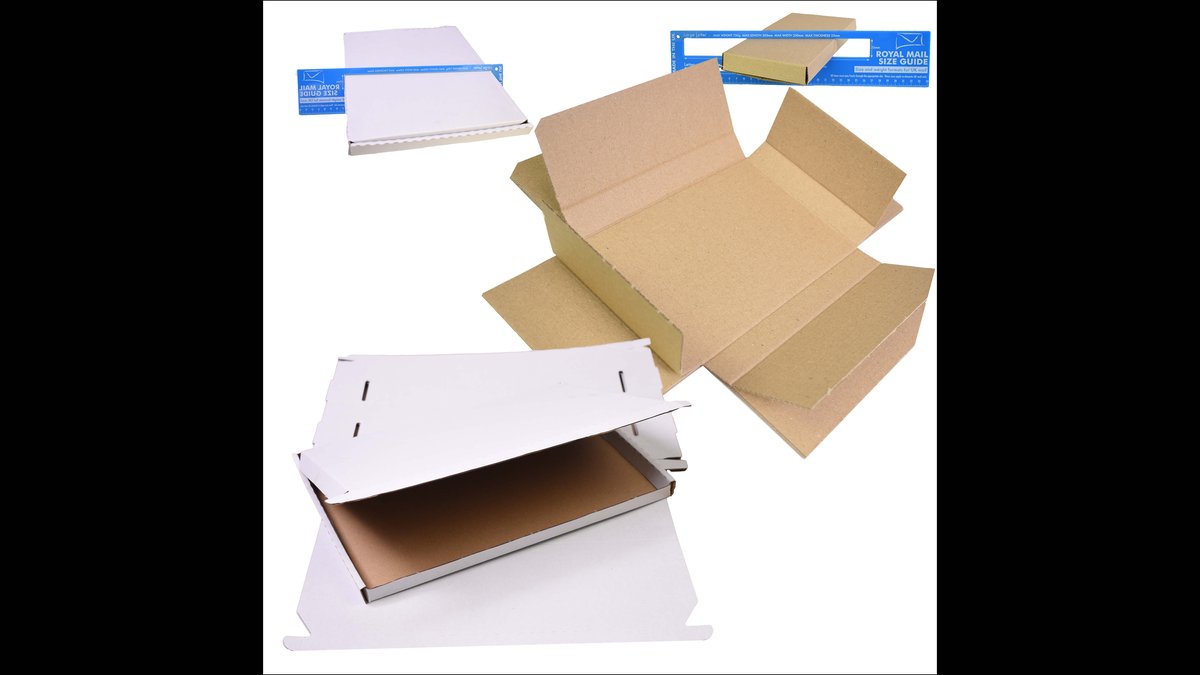
- Rigid large letter boxes (often engineered as FEFCO 0401 or 0427 styles) are designed to hold the 25mm depth precisely, keeping shipments flat.
- Upgrading to exact-match dimension packaging, such as C4, C5, and C6 PIP boxes, is a direct operational strategy for protecting retail margins.
For small business owners and e-commerce sellers handling large shipping volumes, the cost gap between a Large Letter and a Small Parcel frequently adds up, quietly increasing overhead expenses. According to UK specialists from Globe Packaging, achieving consistent postal rates begins with understanding the specific reasons why packages may fail clearance.
One Millimetre Can Cost You Significantly More
Royal Mail's postage pricing relies on a format-based framework. The physical shape and size of a package determine its cost band as much as its weight. The dimensional gap between a Large Letter and a Small Parcel can be as little as a single millimetre in thickness, yet that millimetre can trigger a substantial postage surcharge. Depending on the precise weight of the item, the price jump can exceed 50% or climb even higher under the 2026 pricing structures.
For warehouse teams sending dozens or hundreds of items weekly, misclassification creates a compounding deficit. The frustrating reality is that many merchants pay the higher rate not because their product is inherently bulky, but because their chosen transit packaging expands, pushing them over the strict dimensional limit.
The 25mm Rule: No Wiggle Room
Royal Mail defines the Large Letter category using absolute boundaries. Recognising these physical thresholds forms the basis for cost-efficient commercial shipping.
Official Large Letter Dimensions
According to Royal Mail's official size and weight framework, a Large Letter must not exceed the following metrics:
- Length: 35.3cm
- Width: 25cm
- Thickness: 2.5cm (25mm)
- Weight: 750g (Specific online services, such as Royal Mail Tracked 24 or Tracked 48, allow up to 1kg)
While length and width are rarely the limiting factors for e-commerce operators, thickness remains the hardest dimension to control without purpose-built containers.
How Royal Mail Measures Thickness
Royal Mail measures the thickest point of a package. This is not an average depth, and it does not account only for the flat area where the shipping label sits. If a padded mailer bulges in the centre due to its contents, that central peak is the measured depth. Automated sorting systems are strictly calibrated for flat, uniform geometry. Items that fail to conform are instantly flagged for manual handling or rejected outright. Furthermore, postal staff use physical acrylic slot gauges at regional sorting stages to quickly determine whether a package clears the 25mm gap without applied force.
Why Packages Flare Beyond 25mm
Flaring happens when a package expands at its edges or center, protruding beyond the 25 mm limit. This is rarely a deliberate packing choice; instead, it is usually an inherent flaw in flexible packaging structures.
Soft Packaging and Uneven Contents
Traditional padded bubble mailers and soft-sided envelopes lack a rigid core. As goods move inside, the exterior material molds around the contents instead of providing firm containment. A flat retail item on a warehouse packing desk can arrive at a sorting machine with a noticeable bulge due to transit vibrations or the weight of stacking. Royal Mail's sorting system enforces zero tolerance for such size differences; the thickest part sets the price tier.
Overstuffed Mailers: A Silent Budget Killer
Any thickness exceeding 25mm moves a parcel into the costlier Small Parcel category. This mistake is among the most frequent and financially costly errors made by online sellers, especially when fulfillment teams work quickly and skip manual thickness checks before shipping. Even a seemingly flat mailer can fail the strict slot gauge test if the contents inside are off-center or if operators add extra void fill without accurately measuring the final exterior depth.
What Happens When Your Package Fails the Slot
Failing the 25mm thickness check has immediate negative consequences for both the sender and the end consumer.
Reclassified as a Small Parcel
If a package exceeds the dimensions for a Large Letter at any stage in the postal sorting process, Royal Mail will automatically reclassify it as a Small Parcel. If the original postage was based on the Large Letter rate, the item is considered underpaid. The sender might get the item back, causing delays, or the parcel may go to the local delivery office, where the buyer is responsible for paying the difference.
Held for Surcharge: How Recipients Are Left Waiting
When an underpaid item reaches the recipient's local delivery office, Royal Mail swaps the parcel for a grey "Fee to Pay" card left in the letterbox. The customer then needs to manually pay the owed postage plus an administrative fee before the item is released. This process causes a poor customer experience, erodes brand trust, and often leads to disputes and refund requests. While a single surcharge complaint might seem minor in a scaled e-commerce operation, accumulating across dozens of daily orders, it becomes a significant reputational and operational risk.
Rigid Boxes: The Fix for Flaring
The most reliable operational fix to prevent flaring is removing the structural variable. Swapping soft, flexible outer packaging for rigid corrugated board engineered to hold its precise shape eliminates the problem.
How Anti-Flare Design Holds the 25mm Limit
Rigid cardboard Large Letter boxes are die-cut to precise internal and external dimensions, fixing their depth at manufacture. Unlike standard padded mailers, they do not compress or bulge in response to internal payload shifts. The box maintains a flat exterior profile regardless of movement. This is the core structural principle behind Pricing in Proportion (PIP) boxes: they are purpose-built to pass cleanly through a standard 25mm postal slot.
Packaging industry experts design these Royal Mail Large Letter boxes around this exact physical constraint. High-volume operators typically deploy the Economy Maltese Cross (FEFCO 0401 Style) for rapid, cross-folding assembly, while premium brands opt for Die-Cut (FEFCO 0427 Style) boxes with integrated ear-lock lids. Both formats retain their required depth under the extreme pressure of courier stacking and rough transit handling, without flaring at the crucial edges or corners. That guaranteed dimensional stability keeps ongoing postage costs entirely predictable.
While rigid-backed envelopes offer a slight improvement over standard mailers, a fully enclosed corrugated box delivers the consistent structural retention that standard envelopes cannot match, particularly for heavier goods or items with inherent rigidity.
Exact Dimension Matching: C4, C5, and C6
Replacing guesswork with standardisation is the fastest route to compliance. Commercial packaging suppliers design PIP boxes to match standard paper sizes, providing a snug, protective fit that prevents internal movement while staying under the 25mm hard limit.
- C4 Max Size (349 x 249 x 24mm): Sits just under the absolute Large Letter threshold, maximising internal volume.
- C5 Size (228 x 164 x 22mm): Built for mid-range goods, providing tight transit protection.
- C6 & DL Sizes: Compact variations for smaller, flat components.
What Fits Inside a Large Letter Box
The restrictive 25mm depth naturally rules out bulky cargo, but an extensive range of retail products ships comfortably and securely within a rigid Large Letter PIP box:
- Books, photo albums, and paperback novels
- DVDs, CDs, and standard media cases
- Greeting cards, corporate documentation, and stationery
- Folded clothing, T-shirts, and lightweight apparel
- Phone cases, tablet covers, and small consumer electronics
- Cosmetics and low-profile beauty items
- Jewellery and flat retail accessories
The defining factor is uniform, low-profile flatness. If a product can be packed without exceeding 25mm in total height, an exact-match rigid box is undeniably the most cost-effective way to transit the item. Retailers who regularly dispatch these product types in soft padded mailers are actively overpaying for postage and absorbing entirely avoidable surcharge risks.
Rigid Large Letter Boxes Lock In Your Postage Savings
Unreinforced, soft packaging can cause unpredictable dimensions, which directly reduce profit margins. A bubble mailer that passes the 25mm slot nine times out of ten still results in a costly surcharge on the tenth attempt. Sadly, that single delivery is the one consumers remember. Rigid PIP boxes remove this operational risk. Their depth stays consistent during manufacturing, the flat shape passes through automated sorting systems, and they reliably meet the acrylic slot gauge test.
For businesses managing large volumes, maintaining physical consistency is essential — it distinguishes between a stable shipping budget and one that slowly drains capital. Choosing packaging specifically designed for the Royal Mail Large Letter format is a straightforward change that has a measurable impact on both cost control and customer satisfaction. The initial switch pays for itself quickly, and the margin savings compound over time. Most suppliers of these boxes provide detailed dimension standards and weight limit guidance to help UK businesses fine-tune their shipping setup.