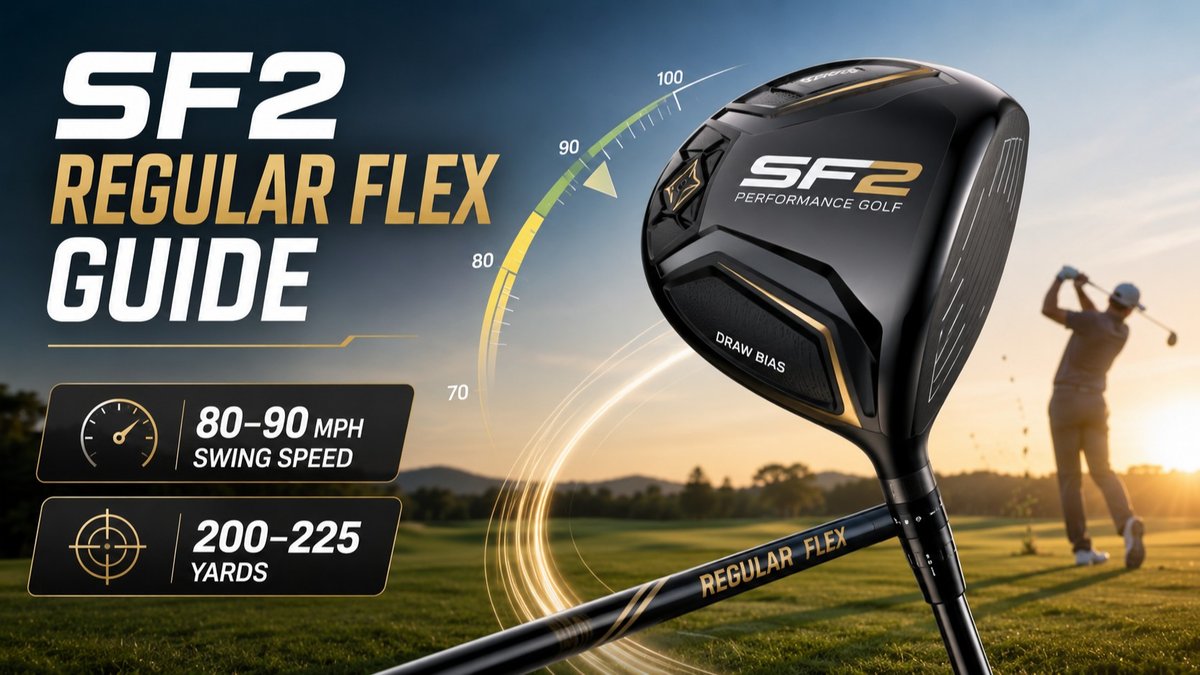
Affordable Golf Courses has released a fitting guide addressing one of the most common equipment mistakes among recreational golfers: selecting incorrect shaft flex for their swing speed. The guide provides a detailed framework matching five distinct SF2 driver flex options to specific swing speed ranges and average driving distances, filling a critical gap in driver fitting education for golfers struggling with slice correction. Most recreational players research driver head features such as closed face angles and heel weighting; the newly published resource emphasizes that shaft flex selection carries equal importance in maximizing the SF2's draw-bias technology.
More details can be found at https://affordablegolfcourses.com/sf2-driver-shaft-flex-guide/
Incorrect flex undermines even well-designed slice-correction drivers. A shaft too stiff for a golfer's speed prevents proper loading during the downswing, causing the clubface to arrive slightly open at impact. This mechanical failure directly counteracts the SF2's 3-degree closed face and heel weighting, making equipment choice alone insufficient without proper fitting guidance. According to golf instruction research, stiff shafts used by golfers with inadequate swing speeds amplify slice tendencies while reducing ball flight height and carry distance, negating the performance benefits that draw-bias technology is engineered to deliver.
The SF2 guide outlines five flex tiers with data-backed benchmarks. Ladies Flex suits swing speeds of 50-65 mph and driving distances under 175 yards. Senior/Soft Flex accommodates 70-80 mph and 175-200 yards. Regular Flex fits 80-90 mph and 200-225 yards. Stiff Flex serves 90-100 mph and 225-250 yards. X-Stiff Flex handles speeds exceeding 100 mph with distances over 250 yards. Each tier allows the clubface to present at impact as designed, enabling the SF2's closed face geometry and weight distribution to function optimally. Regular Flex covers the largest segment of recreational golfers who slice, making it the statistically correct starting point for most buyers in the 200-220 yard average distance range.
Swing speed serves as the primary fitting variable, but the guide addresses tempo nuances and boundary cases to help golfers at flex transition points make informed decisions. A golfer swinging 90 mph with an aggressive transition may require Stiff Flex, whereas a smoother tempo at 82 mph could benefit from Senior Flex despite falling near the Regular Flex range. The resource removes guesswork by providing multiple pathways for identifying correct flex, including distance-to-swing-speed conversion tables for golfers without access to launch monitors.
The SF2 incorporates counterbalancing, a design feature that places additional weight near the grip end to raise the balance point of the club. This configuration makes the clubhead feel lighter and improves clubface control through impact, directly supporting slice correction by helping golfers square the face more consistently. Golf technology research indicates that counterbalancing can increase clubhead speed, improve control, and promote smoother tempo while reducing swing weight by two to three points. The SF2's Regular Flex weighs 57 grams compared to typical 60-65 gram regular flex shafts in OEM drivers; the lighter weight is offset by counterbalancing to maintain appropriate control for the target audience.
Affordable Golf Courses recognizes that not all recreational golfers have access to launch monitors for formal swing speed measurement. The guide provides a distance-to-swing-speed conversion table emphasizing the use of average driving distance rather than best-case drives as a reliable proxy, removing barriers to entry for cost-conscious players who cannot access professional fitting services. By explaining why incorrect flex underperforms through face positioning errors, timing issues, and correction negation, the resource transforms shaft flex selection from an intimidating decision into a structured, data-backed process that builds purchase confidence.
The guide addresses common fitting mistakes, provides boundary-case decision-making support, and includes frequently asked questions addressing the specific concerns golfers have about flex selection and SF2 performance. Recreational players struggling with a slice can now purchase with conviction, knowing their flex choice supports rather than undermines the driver's slice-correction technology.
For more information, visit https://affordablegolfcourses.com/