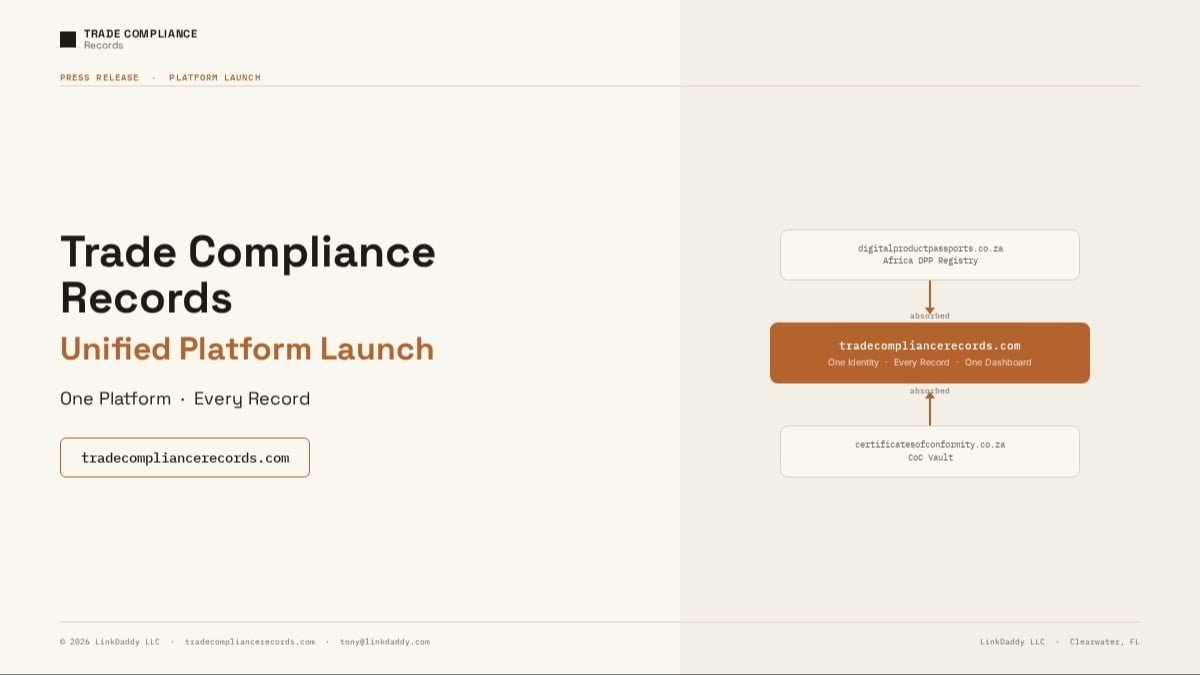
The Story Behind Trade Compliance Records: Why We Consolidated the Network
When LinkDaddy LLC announced the Africa Digital Product Passport Registry in April 2026 and the Certificate of Conformity Vault shortly after, they launched as separate registries with separate brands, separate sign-ups, and separate payment flows. Each one targeted a specific regulatory deadline — the rolling ESPR Digital Product Passport timeline on the export side, the 20 September 2026 PVoC enforcement date on the import side.
A few weeks into operating both, the architecture problem became obvious. A South African manganese exporter shipping to the EU needs a Digital Product Passport. The same exporter, if they import packaging components from China, needs a Certificate of Conformity. Under the original architecture, they'd have two accounts, two identity verifications, two payment relationships, and two dashboards — for what is fundamentally the same compliance need: a permanent, tamper-evident record that a customs officer, a buyer, or an auditor can verify.
So we consolidated. tradecompliancerecords.com is the single commercial platform. One identity check anchors the customer's entity once and reuses it across every record type. One Stripe integration handles every payment. One dashboard surfaces every record the customer holds — export and import, every regulation, every jurisdiction.
The legacy domains haven't disappeared. digitalproductpassports.co.za and certificatesofconformity.co.za continue to operate as topical reference sites. They host the deep regulatory content specific to their original scope — the SABS PVoC Phase 1 product list, the ESPR delegated act timeline, the inspection body roles — and they route visitors who want to actually create or store a record to the consolidated platform.
The technical core is the same as before. Each record is processed in-browser using the SubtleCrypto Web API. The raw document — a Certificate of Conformity PDF, a chemical assay, a carbon calculation — is hashed client-side and the hash is what reaches the platform. The original document never has to transit our servers. What gets stored is the SHA-256 proof, the structured metadata, and the verification URL.
The pricing changed as well. The original registries used a tiered percentage-of-shipment-value minting fee — 2.0% under R1M, scaling down to 0.5% over R10M. That structure made sense for a single-regulation, single-jurisdiction registry where the customer's exposure scaled with cargo value. For a multi-regulation, multi-jurisdiction platform serving small and medium importers and exporters, a flat fee is clearer, more predictable, and more aligned with how the customers actually budget compliance.
The new structure: $349 one-time onboarding, $300-$2,400 annual subscription depending on how many record types and how much volume, $8 per record above the included allowance. The customer always knows the price before they sign up. Nothing scales with declared cargo value.
What the consolidation doesn't change: the underlying record formats, the verification URL structure, the retention periods, the regulatory compliance posture. A Certificate of Conformity created on certificatesofconformity.co.za before consolidation remains valid, remains verifiable at its original URL, and is now also accessible through the consolidated dashboard.
Trade Compliance Records is the platform we should have built first. The individual registries proved each pattern in its own jurisdiction. The consolidated platform is what those patterns add up to.
For more on the architecture, the regulations covered, and the pricing structure, visit tradecompliancerecords.com.