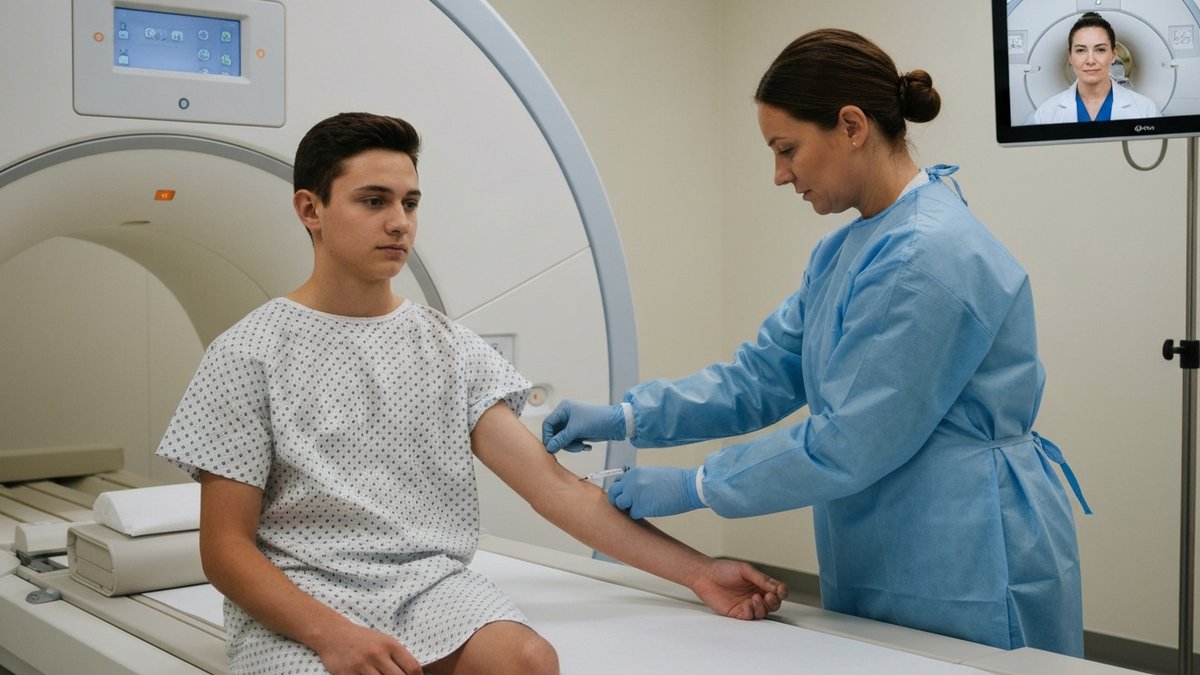
Key Takeaways
- CMS permanently updated its direct supervision rules to allow virtual presence during contrast administration—but only when specific real-time audio/video and documentation requirements are met.
- Response time is the single most critical performance benchmark in virtual contrast supervision, with best-in-class platforms achieving radiologist connection within 30 seconds.
- Scan cancellation rates tied to physician coverage gaps drop to near zero when virtual supervision programs are structured around assured availability rather than best-effort scheduling.
- SLAs in virtual supervision contracts should ensure timestamped, audit-ready documentation for every session—gaps in logging are among the fastest paths to a CMS compliance finding.
- The four benchmarks covered below—response time, cancellation rate, reaction frequency, and documentation completeness—form the operational backbone of any high-performing virtual contrast program.
Virtual contrast supervision has evolved from a pandemic-era workaround into a permanent fixture in outpatient and hospital-based imaging. Permanence does not automatically ensure compliance. For imaging network administrators and hospital executives, the real question is whether the contract terms ensure the performance standards required by CMS and clinical safety, rather than merely confirming whether virtual supervision is permitted.
CMS Demands 'Immediate Availability': Why Seconds-Range Response Times Define Virtual Contrast Coverage
The phrase "immediately available" carries significant regulatory weight. Under CMS direct supervision standards, it means a qualified physician must be able to intervene without delay during contrast administration—requiring presence in real time rather than being reachable by phone or delayed by several minutes. Since the 2026 permanent rule update, that presence can be virtual, but the immediacy requirement has not softened.
That single requirement—immediate availability—is what makes response time the defining performance benchmark in virtual contrast coverage. A platform that takes three minutes to connect a radiologist to a live procedure is not just slow; it is non-compliant. The interval between a technologist initiating a supervision session and a qualified physician joining the live feed is the operational moment when CMS requirements are met or not.
For imaging networks evaluating virtual supervision partners, understanding what seconds-range response times mean in contract terms—and what SLA commitments back them up—is the most important diligence step. ContrastConnect's breakdown of virtual contrast coverage contract structure, SLAs, coverage hours, and terms is a useful framework for understanding what those commitments should look like in practice.
What CMS Actually Requires for Virtual Supervision
Immediate Availability Means Real-Time Audio/Video, Not a Phone Call
CMS direct supervision in the outpatient setting historically required the supervising physician to be physically present in the office suite. The framework has since evolved, but the core expectation—that a physician can intervene immediately—has not changed. What has changed is that "immediately available" can now be met through real-time, two-way audio and video technology rather than physical presence.
A phone call does not satisfy the standard. A text message does not satisfy the standard. Even a video call with a 45-second connection delay creates real compliance exposure if it cannot be documented as immediate. The technology requirement exists precisely because contrast administration carries clinical risk—from mild nausea to severe anaphylaxis—and the supervising physician must be able to direct onsite staff in real time if something goes wrong.
The distinction between compliant virtual supervision and informal phone-based oversight comes down to two things: the immediacy of the connection and the documentation that proves it happened.
How the 2026 Permanent Rule Changed Compliance
CMS's 2026 rule made virtual direct supervision permanent for certain outpatient services, including contrast administration—removing the uncertainty that had kept some imaging networks cautious about fully committing to the model. Before this, virtual supervision operated under temporary waivers that created a "wait-and-see" dynamic for compliance teams.
The permanent rule does not lower the bar. It formalizes it. Imaging networks now have regulatory clarity, but with that clarity comes the expectation that platforms and contracts are built to meet the standard consistently—not just on good days. Since the CMS rule became permanent, compliance rewards networks that have structured SLAs and verified technology in place. Facilities still operating on informal arrangements are at risk.
The Four Performance Benchmarks That Matter Most
1. Response Time: The Primary Operational KPI
Response time is the interval between a technologist initiating a supervision session and a qualified radiologist joining the live connection. It is the most operationally critical metric for remote contrast coverage—and the one most likely to determine whether a facility is compliant or at risk.
A practical benchmark framework for evaluating virtual supervision programs:
- Best-in-class: Radiologist connection established in under 30 seconds.
- Acceptable: Connection within 60 seconds, with a documented escalation protocol.
- At-risk: Any workflow with connection time exceeding 90 seconds or no connection time measured.
Programs that do not define and track response time tend to drift into the at-risk category—not because of bad intent, but because without a contractual benchmark and logging infrastructure, there is no way to detect degradation before it becomes a compliance event. The strongest SLAs in virtual supervision contracts not only set a response-time target; they also include zero-missed-response commitments and an audit trail to verify them.
2. Scan Cancellation Rates Before and After Virtual Supervision
Contrast-related scan cancellations are among the most visible operational failures in imaging. When a study is canceled because no supervising physician is available, the facility absorbs the revenue loss, the patient faces a delay in care, and referring providers lose confidence in the imaging center's reliability. These risks lead to daily operational disruptions at facilities without structured coverage.
High-performing virtual supervision programs target near-zero contrast-related cancellation rates. Studies indicate that virtual supervision platforms with on-demand physician availability significantly reduce cancellations caused by coverage gaps. If a facility still experiences contrast study cancellations after implementing virtual supervision, the root cause is almost always the scheduling architecture or platform reliability—not a fundamental limitation of the virtual model itself.
Tracking the cancellation rate as a pre/post metric when onboarding a virtual supervision partner is one of the clearest ways to quantify operational value. It is also the number that tends to get the CFO's attention fastest.
3. Reaction Frequency and Severity Tracking
Contrast reactions are a predictable clinical reality in any high-volume imaging program. The ACR classifies them into three tiers—mild (self-limiting symptoms), moderate (requiring active treatment), and severe (life-threatening and requiring emergency intervention)—and a well-functioning virtual supervision program should have documented response protocols for all three tiers.
The metrics worth monitoring:
- Total contrast reactions per 1,000 exams administered.
- Breakdown by severity tier (mild, moderate, severe).
- Time from reaction onset to radiologist intervention directive.
- Onsite staff adherence to directed emergency protocols.
- Post-reaction documentation completeness rate.
A radiologist who manages contrast reactions daily—at volume—brings a different level of directive confidence than one who encounters them rarely.
4. Documentation Completeness: The 100% Target
Every virtual supervision session requires a complete, timestamped record. That record is the facility's sole proof of compliance during a CMS review or accreditation audit—and any gaps in it are treated as compliance failures, regardless of whether the supervision itself was clinically sound.
A compliant session record should include:
- Patient identifier and procedure type.
- Supervising physician name and active license verification.
- Session start and end timestamps—automatically generated by the platform to prevent manual data entry errors.
- Confirmation of a real-time audio/video connection.
- Any clinical interventions performed during the session.
- Technologist confirmation signature.
The documentation benchmark is 100% record completeness across all supervised sessions. A missing timestamp, an unsigned record, or a session with no supervising physician credential on file can each constitute an audit finding. Manual logging introduces human error into a compliance-critical workflow—automated documentation removes that risk entirely.
What SLAs in Virtual Supervision Contracts Should Deliver
Assured Response Times and Zero-Missed-Response Commitments
A virtual supervision contract without a defined SLA for response time is a coverage agreement that lacks measurable metrics. The SLA is the mechanism that turns a vendor's stated performance into an enforceable commitment—and for imaging networks that have staked compliance on their supervision partner's reliability, that distinction matters enormously.
At minimum, a well-structured SLA for virtual contrast supervision should specify:
- A maximum response time with a defined measurement methodology (e.g., platform-logged timestamps from session initiation to radiologist connection).
- An explicit zero-missed-response commitment—meaning no supervision request goes unanswered during covered hours.
- Defined escalation procedures when the primary radiologist connection is delayed.
- Uptime commitments for the supervision platform itself, with documented failover infrastructure.
Vague language such as "reasonable response time" or "best efforts" in a supervision contract signals that the SLA has not been operationalized. The strongest contracts in this space specify time thresholds and back them up with platform logging that makes verification straightforward—both for internal operations teams and external auditors.
Audit-Ready, Timestamped Logging Built Into the Platform
The documentation requirement for virtual supervision is not a paperwork formality. It is the mechanism by which a facility proves, retrospectively, that every contrast session met CMS standards in real time. Platforms that automatically generate session records—capturing timestamps, physician credentials, and procedure details without manual entry—eliminate the single biggest source of documentation gaps: manual data entry errors.
Meeting Every Benchmark—Without Adding Onsite Radiologists
The benchmarks discussed throughout this post—sub-30-second response times, near-zero cancellation rates, reaction tracking at volume, and 100% documentation completeness—are practical, achievable operational outcomes when the supervision program behind them is built to the right clinical and technical standard.
For imaging networks evaluating virtual supervision partners or reviewing existing contract terms, the benchmarks above provide a concrete framework for what high performance looks like—and what SLA language should reflect. A coverage program that cannot point to verified response-time data, documented reaction management outcomes, and complete session records is not operating at the standard the current CMS rule demands.
Facilities that define the right metrics, hold their supervision partner to specific contractual commitments, and implement platforms built for audit-ready documentation are reducing cancellations, improving compliance scores, and scaling operations without adding onsite radiologist headcount. Those that rely on informal arrangements or vague SLA language are accumulating risk—often without realizing it until an audit or adverse event makes it visible.
For imaging networks ready to evaluate their virtual supervision infrastructure against these standards, CMS-compliant virtual contrast supervision services are built to meet every benchmark—response time, documentation, reaction management, and cancellation rate—without adding onsite physician coverage.