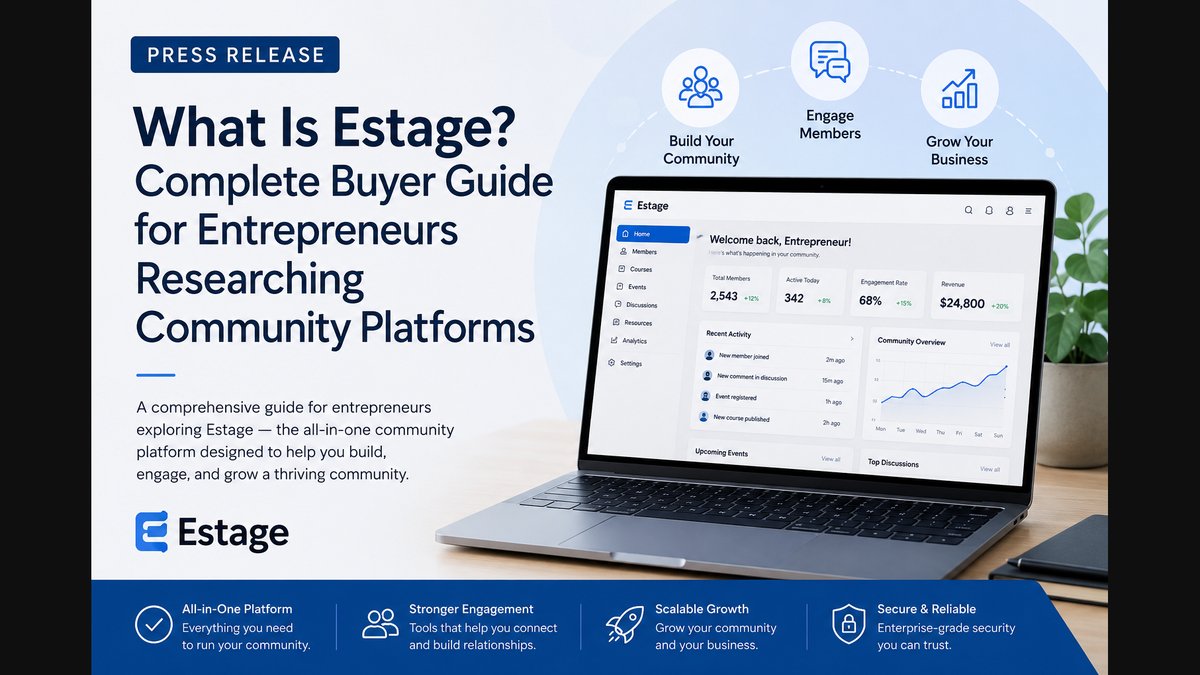
- eStage is an all-in-one business hub platform that consolidates websites, funnels, CRM, course hosting, and more into a single connected system.
- Managing 10+ disconnected tools does not just cost money — it quietly drains time, focus, and momentum from your business every single day.
- eStage was built on the philosophy of owning your digital presence outright, not renting space on platforms that can change the rules overnight.
- The platform is designed specifically for solopreneurs, course creators, coaches, and affiliate marketers who want to simplify without sacrificing capability.
- There are real trade-offs worth knowing before committing — pricing structure and a short learning transition are both covered further below.
Online business has a complexity problem. The average entrepreneur today is juggling a webpage host, a funnel builder, an email CRM, a course platform, a community tool, and a live streaming solution — each with its own login, its own monthly bill, and its own quirks. That is before accounting for the hours lost trying to get all of them to talk to each other. This post breaks down what eStage actually is, what it does, and whether it makes sense as a long-term infrastructure decision for your business.
Running an Online Business on 10+ Disconnected Tools Is Costing You More Than Money
There is a hidden tax on fragmented tech stacks. It shows up as 45-minute troubleshooting sessions when a Zapier integration breaks. It shows up as inconsistent customer data scattered across three platforms. It shows up as decision fatigue every time a new tool promises to solve the one problem your current stack cannot handle.
The financial cost is real — five to ten separate SaaS subscriptions at $30-$200 per month each adds up fast. But the operational cost is what really compounds. Every tool added creates another point of failure, another onboarding curve, and another support queue to wait in when something goes wrong.
Industry trends consistently show that solopreneurs and small business owners are actively seeking ways to reduce this complexity. The appeal is not just about saving money. It is about reclaiming bandwidth — mental and operational — so the focus can stay on building, selling, and serving instead of maintaining infrastructure. Platforms that consolidate funnels, CRM, course delivery, and community features into one system are gaining real traction precisely because the fragmentation problem has become unsustainable for one-person operations.
This is the problem eStage was architected to solve from the ground up. For a deeper breakdown of how it performs in practice, this independent eStage review covers the platform in thorough detail.
What eStage Actually Is
eStage is an all-in-one online business hub platform. At its core, it is a single environment where an entrepreneur can build their web presence, capture and manage leads, sell products, host courses, engage their community, and analyze all of it — without ever leaving the dashboard.
The distinction worth noting is in the word hub. Most platforms are designed around a single function — a funnel builder builds funnels, a course platform hosts courses. eStage is designed around the business owner first, treating every feature as part of one interconnected system rather than a collection of bolt-on modules.
The Central Nervous System Concept
The clearest way to understand eStage's design philosophy is through the central nervous system framing. Just as a nervous system coordinates signals across the entire body from a central point, eStage routes every customer interaction — from first click to post-purchase — through a single connected infrastructure.
That means a lead captured through a funnel page automatically enters the integrated CRM. A course purchase triggers the appropriate gated access. Analytics reflect the full picture of the customer journey, not just a slice of it. Nothing falls through the cracks between platforms because there are no gaps between platforms. Everything shares the same data layer, which is something third-party integrations can never fully replicate.
For solopreneurs especially, this kind of unified visibility is a genuine operational advantage. Knowing exactly where a contact is in the customer journey — without logging into three different tools to piece it together — changes how quickly and confidently decisions can be made.
Founded on Owning Your Digital Presence
eStage was founded by digital marketing entrepreneur Vick Strizheus, and the platform reflects a specific philosophy: a business should never be built entirely on rented land. Social media platforms change their algorithms. Third-party tools get acquired, deprecate features, or raise prices. Integrations break.
The owned presence model built into eStage means the hub, the audience, the content, and the customer data all live in an environment the business owner controls. That is a meaningful structural difference from building a funnel in one tool, hosting a course in another, and keeping a community alive on a Facebook group that Meta could limit reach on tomorrow.
This is not just a philosophical stance — it has practical implications for long-term brand building, data sovereignty, and business resilience. For entrepreneurs thinking beyond the next launch and toward a durable digital infrastructure, that foundation matters.
What's Built Into the Platform
eStage ships with a substantial feature set that covers the full lifecycle of an online business. Rather than listing capabilities in isolation, it helps to understand each feature in the context of the problem it eliminates.
1. Hub Builder (Drag-and-Drop, No Code)
The Hub Builder is eStage's visual website and page construction environment. It operates on a drag-and-drop interface that requires zero coding knowledge, and the output is not generic — templates are built with modern SaaS design sensibilities, not the dated internet marketing aesthetics that have plagued tools like ClickFunnels for years.
Pages built inside eStage are hosted on premium infrastructure, which means fast global load times and 99.9% uptime come standard — not as an add-on. Page speed is a direct factor in both SEO rankings and conversion rates, so this is not a minor footnote. A professional hub can be live within hours, not weeks, even for someone with no technical background.
2. Conversion-Focused Funnels
Beyond standard page building, eStage includes a dedicated funnel architecture designed to guide visitors through a structured sales journey. These are not just landing pages strung together — the funnel system is built to optimize the path from traffic to conversion, with each step designed around buyer psychology and flow.
For affiliate marketers and course creators, this matters enormously. A well-structured funnel built natively inside the same platform as the CRM and checkout eliminates the data loss that typically occurs when stitching together separate tools. The conversion event and the customer record are automatically connected from the moment someone opts in.
3. Integrated CRM
The integrated CRM inside eStage replaces the need for standalone tools like HubSpot or ActiveCampaign for most use cases. Leads, customers, and contacts are managed inside the same environment where the business operates, which means the customer journey is visible in one place from first touch to repeat purchase.
The practical benefit goes beyond convenience. When CRM data lives in the same system as the funnel, the course platform, and the community, segmentation becomes more accurate, follow-up automation becomes more contextual, and the overall customer experience becomes more coherent. That level of coordination is functionally impossible when each piece lives in a different tool.
4. Course Hosting and Gated Memberships
eStage includes a full course hosting and membership environment, removing the need for platforms like Kajabi or Teachable. Courses can be structured, published, and access-controlled directly within the hub. Gated areas — members-only content, premium communities, locked modules — are managed from the same dashboard as everything else.
For educators and coaches, this consolidation has real workflow implications. Student progress, purchase history, and communication all live in the same system. There is no cross-referencing between a course platform and a CRM to figure out who bought what and when. The operational simplicity alone is a meaningful upgrade over the typical multi-tool setup.
5. Live Streaming
Live streaming is built directly into eStage, allowing business owners to broadcast live events, training sessions, or product launches to their audience from within the hub. This removes the dependency on external streaming tools and — more importantly — keeps the audience inside a brand-owned environment rather than a third-party platform.
Live events hosted inside the hub can be connected to opt-in forms, CRM automations, and sales pages without any additional integrations. For coaches or community leaders who use live content as part of their sales or engagement strategy, this native integration is a genuine differentiator.
6. Integrated Analytics and Data Insights
eStage's analytics layer provides visibility into how visitors interact with the hub — which pages drive engagement, where drop-offs occur, and what behaviors correlate with conversions. Because all data flows through one system, the insights are more complete than what any single-tool analytics dashboard can offer.
For a solopreneur making decisions without a data team, having unified analytics is the difference between guessing and knowing. Conversion optimization becomes a practical activity rather than a theoretical one when the data is not fragmented across five different dashboards with five different attribution models.
Which Tools eStage Replaces
eStage's value proposition gets much clearer when mapped against the specific tools it is designed to replace. Depending on the business setup, eStage can consolidate the functions of:
- ClickFunnels — funnel building and page design
- Kajabi — course hosting and membership management
- HubSpot — CRM and contact management
- Teachable or Thinkific — online course delivery
- Mighty Networks or Circle — community and gated content hosting
- StreamYard or similar — live streaming infrastructure
- WordPress plus hosting plus plugins — website and blog infrastructure
- Google Analytics plus third-party trackers — business analytics and visitor insights
The combined monthly cost of running even a modest version of this stack can easily exceed $300-$500 per month, not including integration tools like Zapier required to connect them. That number also does not account for the time investment of managing, updating, and troubleshooting each platform independently. eStage positions its pricing as a consolidation play — the case it makes is that one platform replacing eight is worth more than the sum of its parts.
Who eStage Is Built For
Not every platform fits every operator. eStage is specifically engineered around the needs of performance-focused online business owners who value speed, simplicity, and brand ownership. Three audiences in particular find the most natural fit.
Solopreneurs Tired of Duct-Taping Tools Together
The solopreneur's tech stack problem is unique. There is no IT department, no developer on call, no ops manager to maintain integrations. Every hour spent troubleshooting a broken Zap or reconciling data between platforms is an hour not spent on the work that actually grows the business.
eStage was designed with this constraint in mind. The no-code interface, the single dashboard, the unified data layer — all of it reflects a platform built for someone who needs to run a professional business solo. The reduction in cognitive load alone — one login, one support team, one system to learn — has compounding productivity benefits that are easy to underestimate until the fragmented stack experience has gone on long enough.
Course Creators, Coaches and Consultants
For knowledge-based business owners, the customer journey involves a lot of moving parts: marketing pages, opt-ins, sales funnels, payment processing, course delivery, student management, and ongoing community engagement. Running each of those stages on a different platform creates inconsistent experiences and constant operational overhead.
Inside eStage, a course creator can build the marketing hub, host the curriculum, manage the student CRM, and run live training sessions without ever leaving the platform. The customer experience is consistent because the infrastructure is consistent. That coherence has a direct effect on perceived professionalism — and professional presentation is a genuine conversion driver in the coaching and education space.
Affiliate Marketers and Community Leaders
Affiliate marketers live and die by conversion rates and traffic control. eStage's funnel architecture and hub-centric design make it well-suited for building high-converting bridge pages and authority sites that direct traffic toward offers without the technical noise of managing separate page builders and hosting environments.
Community leaders get a similarly strong fit. Building a private, gated community inside an owned hub — rather than inside a Facebook group subject to algorithm changes and platform policies — gives far more control over the member experience, monetization, and long-term community health. The integrated nature of eStage means community activity and CRM data can inform each other in ways that external platforms simply cannot replicate.
Honest Trade-Offs to Know Before Committing
No platform is without its limitations, and eStage is no exception. Two considerations deserve honest attention before making a decision.
The Price Point vs. The Stack It Replaces
eStage is positioned as a premium platform, and the pricing reflects that. For entrepreneurs on a tight bootstrap budget — the $20 per month per tool crowd — the entry price may feel steep at first glance.
The fair way to evaluate it is against the full cost of the stack it replaces. If the current setup includes separate tools for websites, funnels, CRM, course hosting, and community, the honest comparison is not eStage's price against one of those tools — it is against all of them combined, plus the hidden cost of integration management. For most established solopreneurs and small business operators, that math tends to favor consolidation. For someone just starting out with minimal tool requirements, the calculus may look different in the short term.
The Learning Transition
eStage introduces a Hub workflow that differs from what most entrepreneurs are used to coming from WordPress, ClickFunnels, or Kajabi. The interface itself is designed to be intuitive — and the consensus from independent reviews is that the learning curve is genuinely shallow — but it is not zero.
Users switching from WordPress in particular will notice that the structural thinking is different. A hub-centric model organizes the business differently than a page-by-page website model. That shift in mental framework takes a few days to internalize. It is not a dealbreaker by any measure, but it is worth setting realistic expectations. Most users report being fully operational within a few days of first access, which compares favorably to onboarding timelines for more complex platforms.
eStage Is the Right Move If You're Done Managing a Fragmented Tech Stack
The case for eStage comes down to one core question: is the business being run on infrastructure built for growth, or infrastructure built on compromises? Fragmented stacks are almost always the latter — assembled over time, one tool at a time, each chosen to solve an immediate problem without regard for how it fits into the whole.
eStage offers a different starting point. A single, coherent infrastructure where every feature was designed to work alongside every other feature — not bolted together after the fact. The hub model is not just a product category; it is a structural shift in how an online business is organized and operated.
For solopreneurs and small business owners who have hit the ceiling of what a fragmented stack can realistically support, the value proposition is straightforward. One platform, one data layer, one login — and a business infrastructure that grows with the operation rather than against it. The trade-offs around pricing and transition time are real but manageable. The long-term operational clarity that comes from running a unified system is harder to put a number on, and that is precisely where the value lives.
For more expert breakdowns of platforms and tools that help entrepreneurs simplify and scale their digital operations, Saaswired covers the SaaS space with practical, no-fluff analysis built for online business owners.