Key Takeaways
- Traditional contact forms create friction that drives away motivated buyers before they ever connect with your business.
- A quote-first strategy shows visitors a personalized price range before asking for contact details, which filters out tire-kickers automatically.
- Lead scoring can lift ROI by up to 77% - and self-qualified leads shorten the sales cycle dramatically.
- Exclusive leads consistently outperform shared leads on close rate and return on investment, even when the upfront cost is higher.
- LeadAppz structures a full five-step quote-first funnel that pairs lead capture with a content distribution engine to close the loop from traffic to revenue.
Most service businesses are quietly losing their best prospects - not to competitors, but to a generic contact form. The visitor showed up, looked around, wanted a number, and left when they did not get one. That cycle repeats hundreds of times before anyone notices the real problem is not traffic. The problem is the first thing the site asks visitors to do.
Traditional Contact Forms Create Friction That Kills Conversions
The standard "Request a Quote" or "Contact Us" form has been a fixture on service business websites for decades. The concept is simple: capture the lead first, deliver value later. In practice, it rarely works that smoothly. Visitors arrive with one question - what is this going to cost me? - and instead of an answer, they get a form asking for their name, phone number, and email before anything useful is returned.
That sequence creates a friction wall at exactly the wrong moment. The visitor is curious and engaged, which is the best possible time to move them forward. Asking for personal information before providing any value signals to the buyer that their interests come second. Many simply leave.
What Form-First Actually Costs You
Friction Fatigue: Too Many Fields, Zero Value
Every additional field on a contact form is a small tax on the visitor's patience. Research consistently shows that excessive form fields and a lack of immediate value cause potential customers to abandon the process entirely - a pattern sometimes called friction fatigue. The visitor has not received anything yet, so there is no sense of investment to keep them moving forward. The cost is not just a bounced session; a high-intent buyer who was ready to hire someone walks away empty-handed.
Buyers Who Want Pricing Go Elsewhere
Modern consumers research pricing before they ever contact a business. When a site withholds pricing entirely, a meaningful segment of visitors - particularly those close to making a decision - interpret that as a reason to look elsewhere. Buyers who want to assess value against cost often treat pricing transparency as a baseline signal of trustworthiness. When a competitor's site offers even a ballpark number, the comparison is already over.
How Quote-First Flips the Equation
Visitors See a Price Range Before Sharing Anything
A quote-first approach inverts the traditional sequence. Instead of collecting contact details and promising to respond with pricing later, the visitor walks through a short series of questions about their project - scope, timing, size - and receives a personalized price range on the spot. Contact information comes after the estimate, not before it. That single change restructures the entire value exchange: the visitor gets something meaningful first, which earns the business the right to ask for contact details in return.
Interactive pricing tools that deliver personalized results have been shown to significantly increase engagement and conversion rates compared to static form-based approaches. Interactive content consistently generates more engagement than static formats - not because the content is flashy, but because it answers the question the visitor actually came to have answered.
Upfront Pricing Lets Visitors Self-Qualify Before You Ever Follow Up
There is a filtering effect built into the quote-first model that forms cannot replicate. When a visitor sees a price range and proceeds anyway, they are signaling budget alignment. When the estimate falls outside their range, they leave before submitting - which means no wasted follow-up call, no estimate appointment for a project that was never going to close. The leads that do come through have already confirmed they are comfortable with the ballpark. That is a different conversation than a cold form fill from someone who had no idea what the project might cost.
Why Upfront Pricing Builds Trust and Closes More Jobs
Pricing Transparency as a Competitive Advantage
Upfront pricing does more than reduce friction - it shifts how buyers perceive the business. Pricing transparency is a proven driver of customer trust, and trust directly influences purchasing decisions. When a contractor or service provider is willing to put numbers on the screen before the first conversation, it signals confidence in the value being delivered. That psychological anchor - the first number a customer sees - shapes how they evaluate everything that follows, including the final quote and competitor comparisons.
Pre-Qualified Leads Enable Faster, More Effective Follow-Up
Speed of response is one of the most underappreciated variables in service business sales. Conversion rates drop sharply when follow-up takes more than five minutes, and leads can go cold in as few as fifteen minutes. That window is nearly impossible to hit when the first call is exploratory - gathering project details the form should have captured, figuring out whether the lead is even a fit. Pre-qualified leads with project scope and a price range already attached allow follow-up to skip straight to scheduling, which keeps the conversation warm and shortens the path to a signed contract.
Exclusive, Scored Leads vs. Shared Leads from Angi
Shared Leads: Higher Volume, Lower ROI
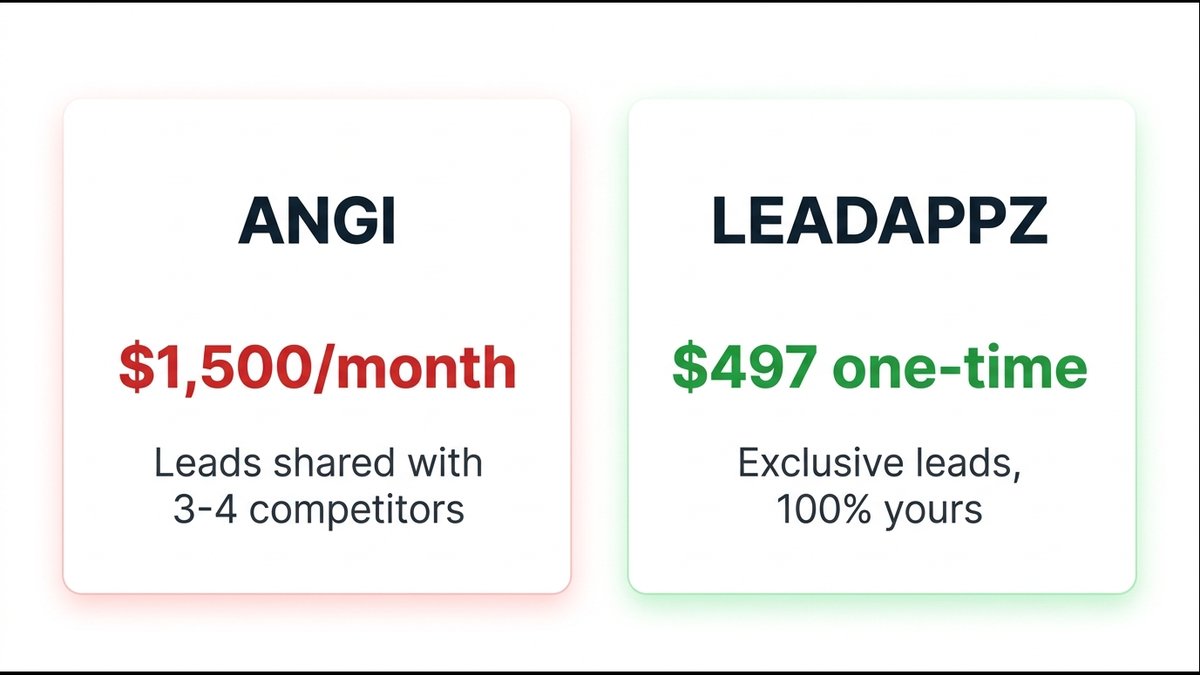
Platforms like Angi operate on a shared-lead model: a homeowner submits a request, and that request gets distributed to multiple contractors simultaneously. Volume looks attractive on the surface, but each lead immediately becomes a race. Every contractor who received the same name and phone number is competing on response speed and price, which compresses margins and rewards whoever answers fastest rather than whoever does the best work. Exclusive leads - delivered to one business only - consistently produce higher close rates and better ROI, even when the per-lead cost is higher, because the competitive pressure is eliminated entirely.
Lead Scoring and the 77% ROI Lift
Not all leads that come through a quote-first funnel are equal, and treating them as if they are wastes the efficiency the model creates. Lead scoring - rating each lead based on project size, urgency, and scope - allows businesses to prioritize follow-up around the highest-value opportunities. Studies show that lead scoring can improve lead generation ROI by up to 77% and increase lead-to-opportunity conversion rates by a similar margin. A lead flagged as "Strong" with an ASAP timeline and a premium project scope deserves a different response than one marked "Weak" from someone gathering ballpark numbers months out.
How LeadAppz Structures a Quote-First Flow
A Multi-Step Funnel: Service Selection Through to Lead Capture
The LeadAppz quote-first platform builds its lead capture around a five-step funnel designed for service businesses. The visitor picks their service, indicates timing and urgency, describes project scope, receives a personalized price range - and only then submits contact information. By the time a lead hits the owner's inbox, it carries a project scope, a price range, a timing flag, and a strength score (Strong, Possible, or Weak). Hot leads - ASAP timing combined with a premium scope - get flagged for priority follow-up automatically.
Customizable Rates Ensure Every Lead Matches Your Actual Work
One practical issue with generic estimator tools is that the numbers they produce do not reflect local market conditions or the specific services a business actually offers. LeadAppz addresses this directly: pricing tables are adjustable, so a roofing contractor can set their own labor rates, material markups, tear-off costs, and story factors. Service toggles let businesses turn off work they do not take on. The result is that every lead that comes through is priced to match what the business would actually quote - not a national average that leads to awkward conversations at the estimate.
The Closed Loop: From Traffic to Closed Revenue
Content Distribution Paired With On-Site Lead Capture
Lead capture only works if traffic exists to capture. LeadAppz pairs its quote-first app with Visibly Ranked — a content distribution service that publishes across 300+ platforms to drive high-intent search traffic back to the estimator. The two sides work together: content brings visitors in, the quote-first funnel converts them into scored leads, and the dashboard tracks each lead through to closed revenue. One Dallas-area roofing contractor went from invisible online to Page 1 of Google in three months using that combined approach. The app captures the lead; the visibility campaign makes sure there are leads to capture.
Why Quote-First Leads Close at Higher Rates
The gap between a form-first and a quote-first strategy is not cosmetic. Collecting contact details from anyone willing to fill out a box is a fundamentally different outcome than capturing motivated buyers who already know the price range and moved forward anyway. That population closes faster, wastes less follow-up time, and generates higher revenue per lead. The mechanics - upfront pricing, self-qualification, lead scoring, exclusive delivery - each solve a specific failure point in the traditional form-based model, and together they compound into a meaningfully better pipeline.
Service businesses that have already shifted to this model are not getting more leads. They are getting fewer, better ones - and closing a higher percentage of them without the race-to-the-bottom dynamic that shared lead platforms create. Shared lead platforms force contractors to keep paying month after month for the same leads; quote-first lets contractors own their system outright — stop renting leads, start owning them. The question is not whether quote-first works. The question is whether the current approach is worth defending.
See how LeadAppz structures quote-first lead capture at leadappz.com — including a live demo you can click through without signing up."