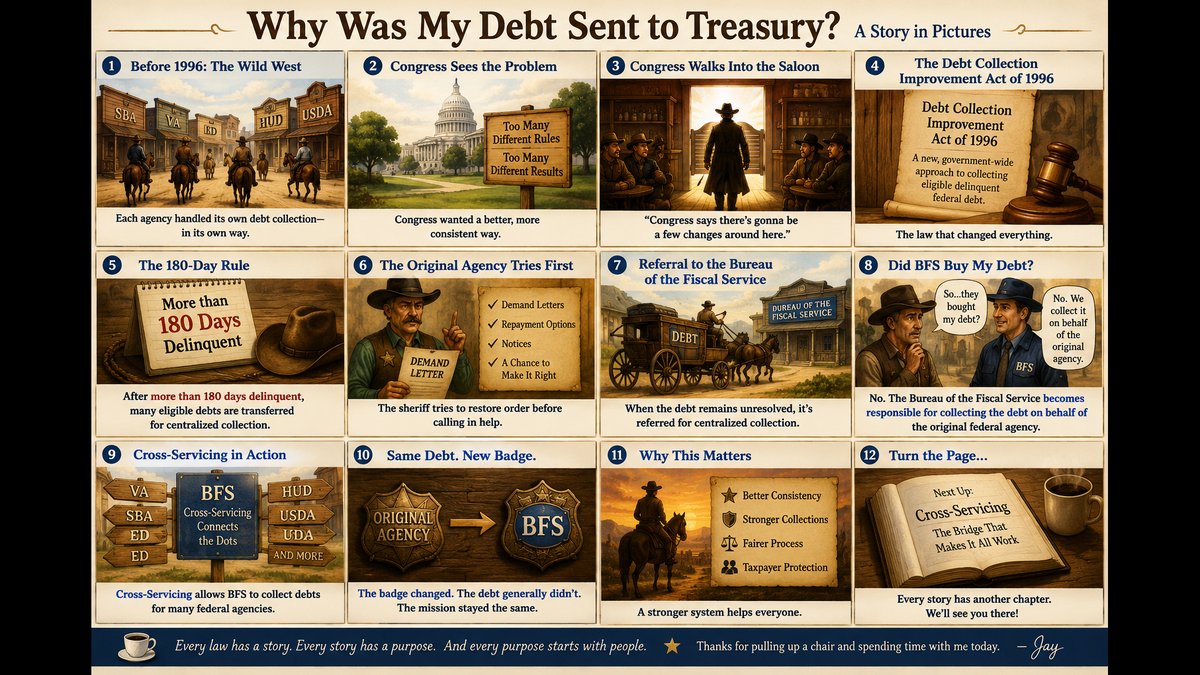
Key Takeaways:
- Before 1996, federal agencies largely handled collection of their own delinquent debts. Congress passed the Debt Collection Improvement Act to create a more consistent, government-wide collection process.
- Federal agencies transfer eligible delinquent nontax debts to the Bureau of the Fiscal Service for centralized collection after they become more than 180 days delinquent, unless an exception applies.
- The Bureau of the Fiscal Service does not buy your debt. It collects the debt on behalf of the original federal agency, which remains your creditor.
- Before a debt is transferred, the originating agency attempts to collect the debt by sending demand letters, explaining available repayment options, and notifying you that the debt may be referred to Treasury.
- Understanding why your debt was transferred helps you understand who is collecting your debt, why Treasury became involved, and what happens next.
"Wait...I Didn't Borrow Money From the Bureau of the Fiscal Service."
It's one of the first questions that comes to mind when a collection notice arrives from Treasury. After all, your debt may have started with the Small Business Administration, the Department of Veterans Affairs, the Department of Education, or another federal agency.
The answer goes back to a law Congress passed in 1996. The Debt Collection Improvement Act changed how eligible delinquent federal debts are collected and explains why Treasury became part of the process.
How Your Debt Makes Its Way to Treasury
It Doesn't Happen Overnight
Your debt is not transferred to Treasury the moment you miss a payment. The originating federal agency first attempts to collect the debt. Those efforts often include sending demand letters, explaining available repayment options, and notifying you that the debt may be referred to the Bureau of the Fiscal Service if it remains unresolved.
For many eligible delinquent nontax debts, Congress established a general transfer point after the debt becomes more than 180 days delinquent, unless an exception applies. That's when the Bureau of the Fiscal Service steps in to continue the collection process on behalf of the original federal agency.
Treasury Didn't Buy Your Debt
One of the biggest misconceptions we hear is that Treasury purchased the debt from the original agency.
That's not what happened.
The Bureau of the Fiscal Service collects the debt on behalf of the original federal agency, which remains your creditor. Treasury's role changed. Ownership of the debt did not.
Congress Drew a Line
Before the Debt Collection Improvement Act of 1996, each federal agency largely decided how it would collect its own delinquent debts. Some agencies had well-established collection programs. Others had fewer resources or different priorities.
Congress wanted a more consistent, government-wide approach.
One of the biggest changes was establishing a framework that would eventually move eligible delinquent nontax debts into the Bureau of the Fiscal Service's centralized collection system.
The 180-Day Rule
For many eligible delinquent nontax debts, the Debt Collection Improvement Act established a general point at which federal agencies transfer debts to the Bureau of the Fiscal Service for centralized collection.
That transfer generally occurs after a debt becomes more than 180 days delinquent, unless an exception applies under federal law or regulation.
The original federal agency doesn't simply stop working the account. Instead, Congress created a process that allows Treasury to continue collection efforts on the agency's behalf.
Think of It Like the Sheriff Calling for Backup
Imagine a Wild West sheriff trying to keep order in town.
He doesn't call in the U.S. Marshals the first day trouble starts.
He handles the situation himself.
But eventually, there comes a point when additional help is needed.
That's the idea behind the 180-day transfer. Treasury wasn't called because the original federal agency gave up. Treasury became involved because Congress created a centralized system to help collect eligible delinquent federal debts more consistently.
.
Treasury Didn't Buy Your Debt
One of the biggest misconceptions we hear is that the Bureau of the Fiscal Service purchased the debt from the original federal agency.
That's not what happened.
When a debt is referred for centralized collection, the Bureau of the Fiscal Service becomes responsible for collecting the debt on behalf of the original federal agency. The agency that originally made the loan or created the debt remains your creditor.
Think back to our Wild West sheriff.
When the sheriff called for backup, he didn't hand over ownership of the town. He simply asked for help restoring order.
The same idea applies here. Treasury became involved because Congress created a centralized collection system, not because ownership of the debt changed.
What Happens Next?
Now that you understand why your debt was sent to Treasury, you're in a better position to understand the collection process that follows.
The Bureau of the Fiscal Service may use programs such as Cross-Servicing, the Treasury Offset Program, and Administrative Wage Garnishment to collect eligible delinquent federal debts. Understanding how those programs work begins with understanding why Treasury became involved in the first place.